Tag: #RAG

  • Breaking Down Multimodal Embeddings: How Machines Understand Mixed Data

    Breaking Down Multimodal Embeddings: How Machines Understand Mixed Data

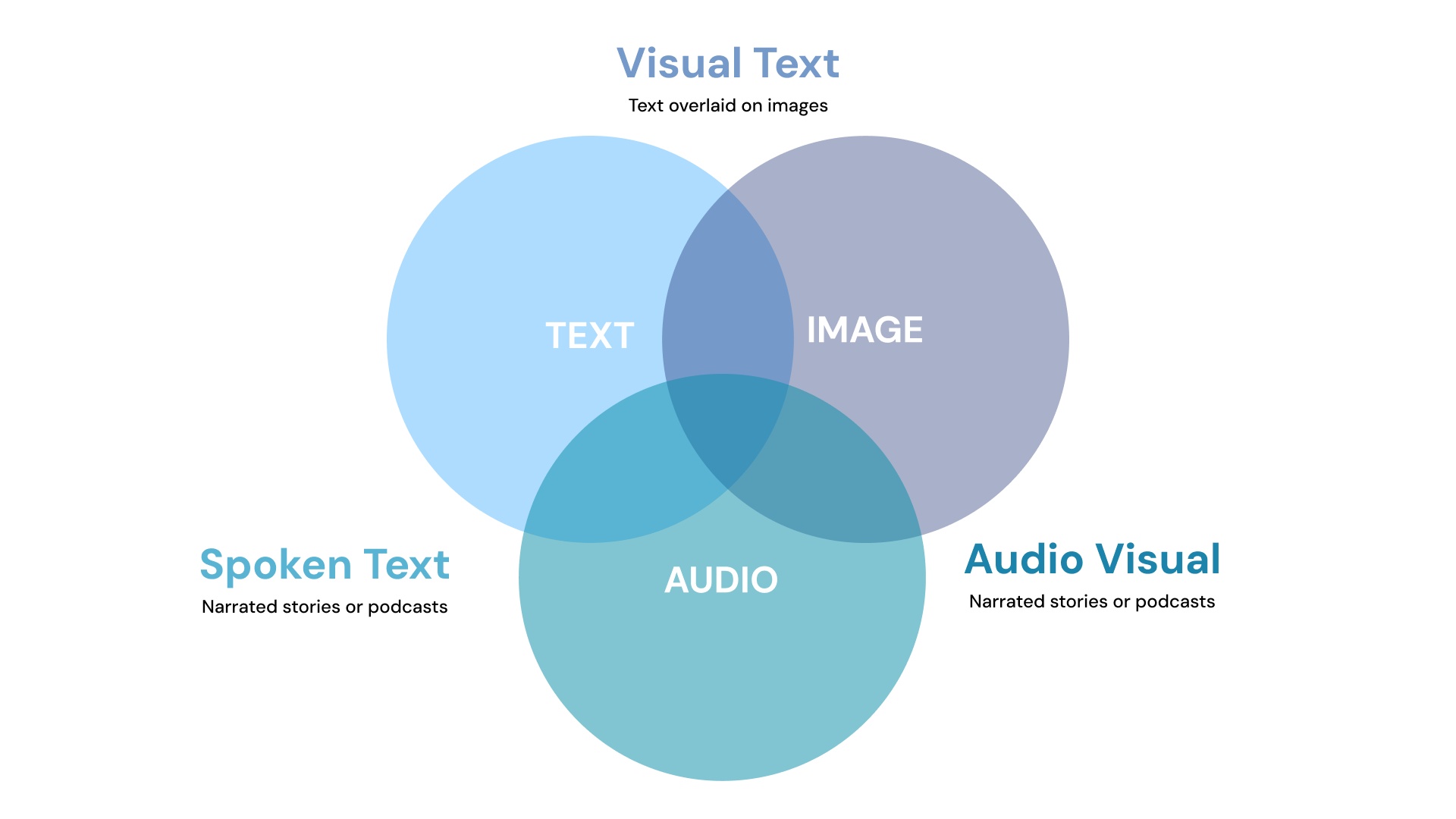
    AI-integrated systems once thrived in silos: text models parsed documents, vision models recognized images, and models detected sounds. Yet people rarely process information in isolation. We read captions under pictures, watch videos with sound, and naturally link meaning across channels.

    Multimodal embeddings bring this human-like perception to AI, creating a unified approach to understanding and relating text and images. At DataNeuron, we’re evolving our Retrieval-Augmented Generation (RAG) framework from text-only to a truly multimodal experience, enabling more context-aware insights across diverse data types.

    From Single-Modality to Multimodal Intelligence

    Traditional machine learning pipelines were siloed by modality:

    • Natural Language Processing (NLP) for text
    • Computer Vision (CV) for images

    Each used its own features, architectures, and training data. That’s why a text embedding could not directly relate to an image feature. However, real-world tasks need cross-modal understanding. 

    A self-driving car combines camera feeds with sensor text logs. An e-commerce engine pairs product descriptions with photos. A customer support bot must interpret text, as well as screenshots or voice messages. Without a common representation, these systems can’t easily search, rank, or reason across mixed inputs.
    What Are Multimodal Embeddings?

    An embedding is simply a vector (a list of numbers) that encodes the meaning of data.

    • In text, embeddings map semantically similar words or sentences near each other in vector space.
    • In images, embeddings map visually similar content near each other.

    Multimodal embeddings go further… they map different modalities into a shared vector space. This means the caption “a red sports car” and an actual photo of a red sports car end up close together in that space.

    How Do Multimodal Embeddings Work?

    There are two main approaches, both relevant to DataNeuron’s roadmap.

    1. Convert Non-Text Modalities into Text First

    Here, each modality is preprocessed into text-like tokens:

    • Images → captions or alt-text via a vision model

    Once everything is in text, we can use a text embedding model (e.g., OpenAI, Cohere, or open-source models) to generate vectors. DataNeuron currently offers this method by default: you upload mixed data, our system normalizes it to text, and we build a unified vector store for retrieval.

    2. Direct Multimodal Embedding Models

    Alternatively, we can train or use models that natively embed text or images into the same space without converting them. DataNeuron is experimenting with this second route, where we integrate open-source and licensed (paid) embeddings to give our users both options.

    Why Multimodal Embeddings Matter for RAG

    Retrieval-Augmented Generation (RAG) traditionally enhances LLMs by retrieving text chunks relevant to a query. But enterprise data rarely lives as plain text. You may have:

    • PDFs with embedded images
    • Sensor logs with metadata

    By extending RAG into multimodal territory, DataNeuron enables users to:

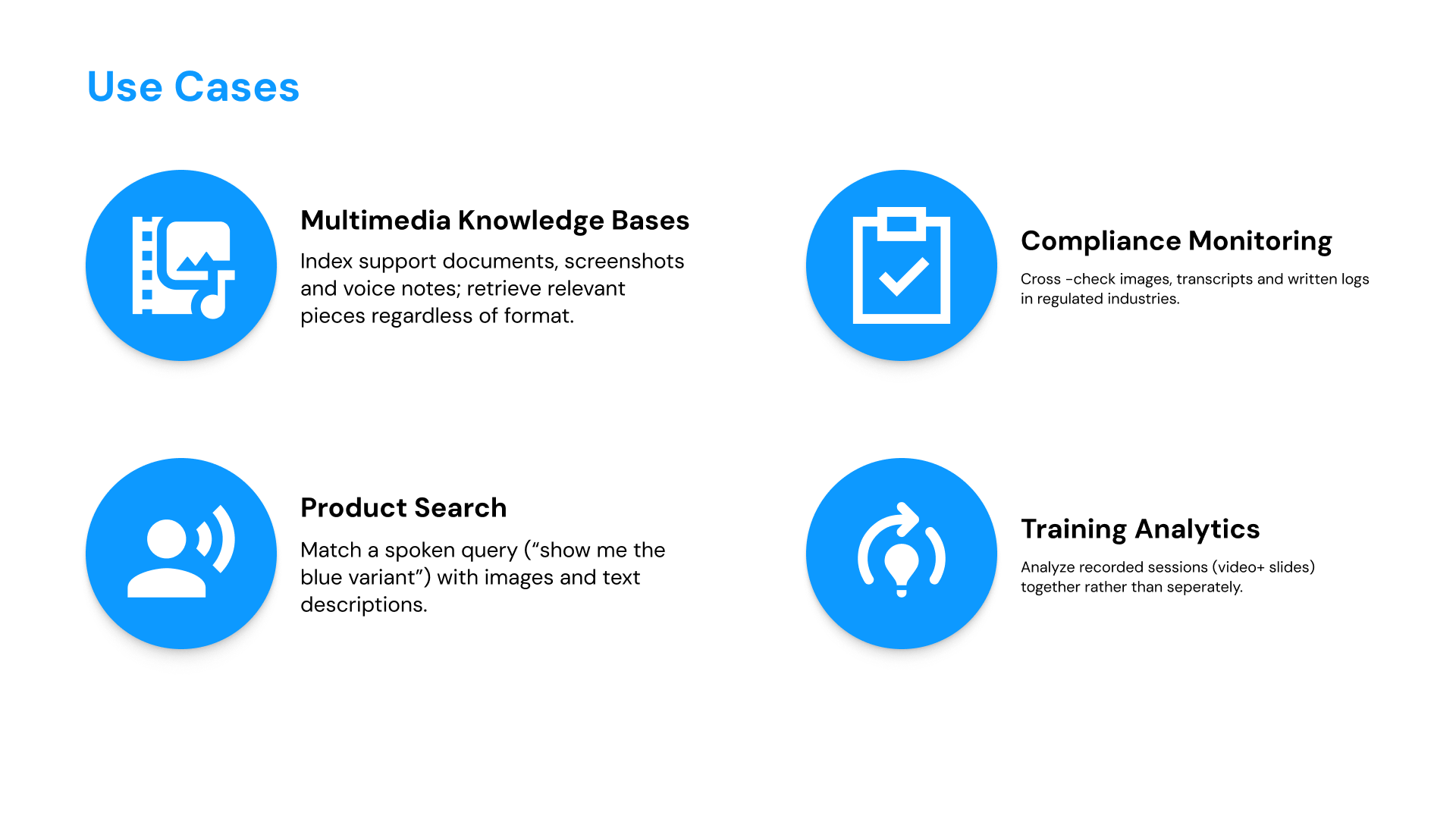
    • Search across formats (“Find me slides, videos mentioning Product X”)
    • Contextualize outputs (“Generate a summary of this image plus its caption”)

    Reduce preprocessing overhead (no manual transcription or tagging needed)

    Humans naturally combine multiple senses to understand context. Multimodal embeddings give machines a similar capability, mapping text, images, and sounds into a shared meaning space.  

    For DataNeuron, adding multimodal embeddings on top of our RAG stack means customers no longer need to flatten their data into text. Instead, they can bring their data as-is and still get unified, context-aware retrieval and generation.  This democratizes multimodal AI for enterprises that can’t afford to train such models themselves. We’re curating and integrating the best open and commercial models to give our users immediate and practical power. 
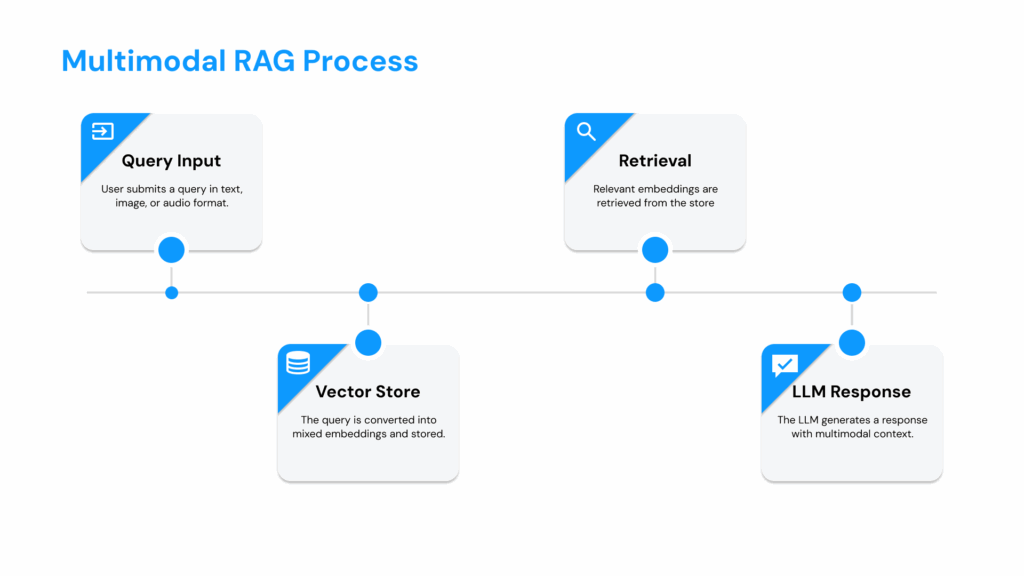
    Multimodal Retrieval-Augmented Generation (RAG) process diagram illustrating input query, vector store search, document retrieval, and LLM response generation.

    DataNeuron’s Multimodal Embedding Strategy

    We’ve structured our approach around three pillars:

    Unified User Experience

    Users can upload or stream text, images, or audio. Our system either converts non-text into text first or applies a multimodal embedding model directly. The resulting vectors live in a single store, so cross-modal queries “just work.”

    Choice of Embedding Models

    We support both open-source and paid/licensed embeddings. This lets customers start with free models for experimentation, then switch to higher-accuracy or enterprise-grade embeddings without rewriting pipelines. Some examples of embedding models supported by DataNeuron include open-source: CLIP, AudioCLIP, OpenCLIP; paid APIs: commercial text + image embeddings from major providers.

    Future-Ready Architecture

    Our vector store and RAG engine are designed to handle not only text, image, and audio today, but also include richer modalities like video and sensor data tomorrow. We’re treating “embedding as a service” as a core building block of DataNeuron.
    Humans naturally combine multiple senses to understand context. Multimodal embeddings give machines a similar capability, mapping text, images, and sounds into a shared meaning space, unlocking better search, smarter generation, and more intuitive user experiences.

    At DataNeuron, we’re extending our platform from text-centric RAG to truly multimodal RAG. By supporting both “convert to text first” and “direct multimodal embedding” approaches, in addition to offering open-source and paid models, we provide customers with flexibility and scalability.
  • The Evolution from Text-Only AI to Multimodal RAG

    The Evolution from Text-Only AI to Multimodal RAG

    For years, Retrieval-Augmented Generation (RAG) systems have relied exclusively on text, from extracting, embedding, and generating knowledge purely from written data. That worked well for documents, PDFs, or transcripts. But enterprise data today is far more diverse and complex than plain text.

    Think about how information really flows in an organization:

    • Engineers exchange dashboards and visual reports.
    • The design team shares annotated screenshots.
    • Customer support records voice logs.
    • Marketing stores campaign videos and infographics.

    Each of these contains context that a text-only RAG cannot interpret or retrieve. The system would miss insights locked inside images, audio, or visual reports simply because it only “understands” text. 

    That’s where multimodal RAG comes into the picture. It allows large language models (LLMs) to retrieve and reason across multiple data formats (text, image, audio, and more) in a unified workflow. Instead of flattening everything into text, multimodal RAG brings together the semantics of different modalities to create more contextual and human-like responses.

    How Multimodal RAG Works

    At its core, multimodal RAG enhances traditional RAG pipelines by integrating data from multiple modalities into a single retrieval framework. There are two primary approaches that DataNeuron supports:

    1. Transform Everything into Text (Text-Centric Multimodal RAG)

    In this approach, all data types — whether image, video, or audio are converted into descriptive text before processing.

    • Images → converted into captions or alt-text using vision models.
    • Audio or video → transcribed into text using speech recognition.

    Once everything is transformed into text, the RAG pipeline proceeds as usual:
    The text data is chunked, embedded using a text embedding model (OpenAI, etc.), stored in a vector database, and used for retrieval and augmentation during generation.

    Advantages:

    • Easy to implement and integrates with existing RAG systems.
    • Leverages mature text embedding models and infrastructure.

    Limitations:

    • Some modality-specific context may be lost during text conversion (e.g., image tone, sound quality).
    • Requires extra preprocessing and storage overhead.

    This method forms the foundation of DataNeuron’s current multimodal pipeline, ensuring a smooth path for teams who want to start experimenting with multimodal inputs without changing their RAG setup.

    2. Native Multimodal RAG (Unified Embeddings for Mixed Formats)

    The second approach skips the text conversion layer. Instead, it uses embedding models that natively support multiple modalities, meaning they can directly process and represent text, images, and audio together in a shared vector space.

    Models like CLIP (Contrastive Language Image Pre-training) and AudioCLIP are examples of this. They learn relationships between modalities. For instance, aligning an image with its caption or an audio clip with its textual label, so that both the image and the text share semantic proximity in vector space.

    Advantages:

    • With higher accuracy, the original semantic and visual information is preserved.
    • Enables advanced search and retrieval (e.g., querying an image database using text, or retrieving audio clips related to a written description).

    Limitations:

    • Computationally heavier and more complex to fine-tune.
    • Fewer mature models are available today compared to text embeddings.

    At DataNeuron, we are actively experimenting with both open-source (e.g., OpenCLIP) and enterprise-grade (paid) embedding models to power multimodal RAG. This dual strategy gives users flexibility to balance performance, cost, and deployment preferences.

    Benefits of Multimodal RAG over Text-Only AI

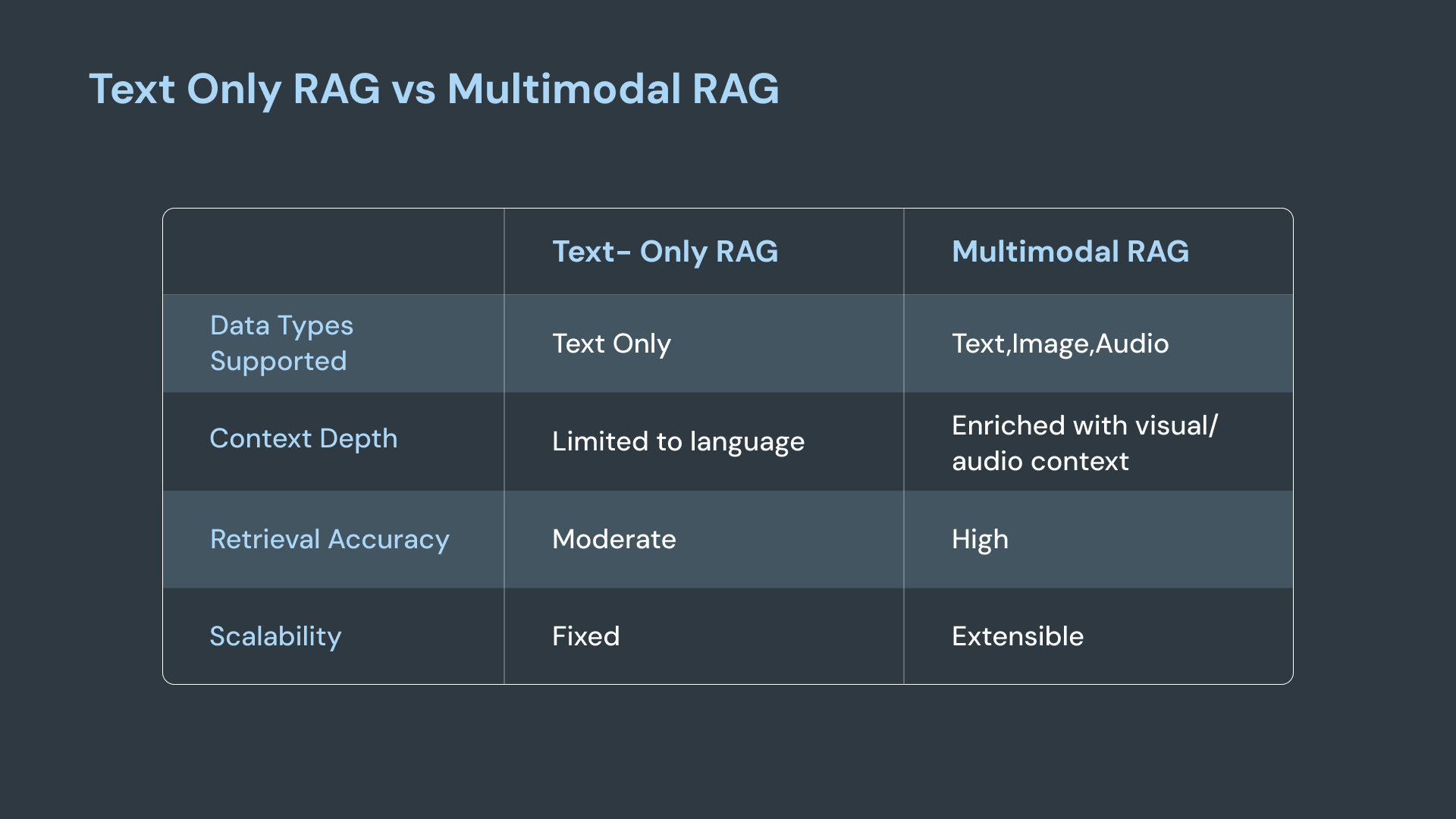
    Transitioning from text-only RAG to multimodal RAG is a shift toward complete context understanding. Here’s how multimodal RAG enhances intelligence across business workflows:

    1. Deeper Contextual Retrieval

    In text-only RAG, context retrieval depends on written tokens. With multimodal RAG, the system can relate text to associated visuals or audio cues.
    For example, instead of returning only a report, a query like “show me the marketing campaign for Q2” can also retrieve the campaign poster, promotional video snippets, or screenshots from the presentation deck, all semantically aligned in one search.

    2. Unified Knowledge Base

    Multimodal RAG consolidates multiple data silos (PDFs, images, voice logs, infographics) into a single retrieval layer, so teams no longer have to manage separate tools or manual preprocessing. This unified vector store ensures that information from all sources contributes equally to the model’s reasoning.

    3. Enhanced Accuracy in Generation

    By retrieving semantically linked data across formats, multimodal RAG provides a richer grounding context to LLMs. This leads to more accurate and contextually relevant responses, especially in cases where visual or auditory cues complement text (e.g., summarizing a product design image along with its specs).

    4. Scalability Across Data Types

    Enterprise data continues to diversify from 3D visuals to real-time sensor logs. A multimodal RAG pipeline is future-ready, capable of adapting to new formats without rebuilding the system from scratch.

    5. Operational Efficiency

    Rather than running separate AI systems for each data type (text, image, or audio), multimodal RAG centralizes embedding, indexing, and retrieval. This simplifies maintenance, reduces compute duplication, and accelerates development cycles.

    Together, these changes make multimodal RAG a natural evolution for enterprise AI platforms like DataNeuron, where knowledge is never just text but a blend of visuals, speech, and data.

  • RAG or Fine-Tuning? A Clear Guide to Using Both

    RAG or Fine-Tuning? A Clear Guide to Using Both

    In the rush to implement AI across organizational operations, one must strike a balance between adaptability and accuracy. Should you rely on retrieval-based intelligence to maintain agility, or should you hardwire experience into the model to ensure precision?

    This is a strategic decision, and making the right call at the right time can determine the success of everything from automated policy interpretation to conversational AI. Both offer paths to smarter AI; however, they serve different needs, and selecting the wrong one can be the difference between insight and illusion.

    RAG: Fast, Flexible, and Context-Aware

    Retrieval-Augmented Generation (RAG) is where most organizations begin their journey. Instead of retraining an LLM, RAG enhances its responses by pulling real-time context from a vector database. Here’s how it works:

    1. Vector Encoding: Your documents or knowledge base are embedded into a vector store.
    2. Prompt Engineering: At inference time, the user’s query triggers a semantic search.
    3. Dynamic Injection: Relevant documents are retrieved and included in the prompt.
    4. LLM Response: The model uses this injected context to generate a grounded, informed response.

    This process is compute-efficient, versionless, and ideal when knowledge is fluid or frequently updated, such as government policies, IoT feeds, or legal frameworks.

    Where Does RAG End?

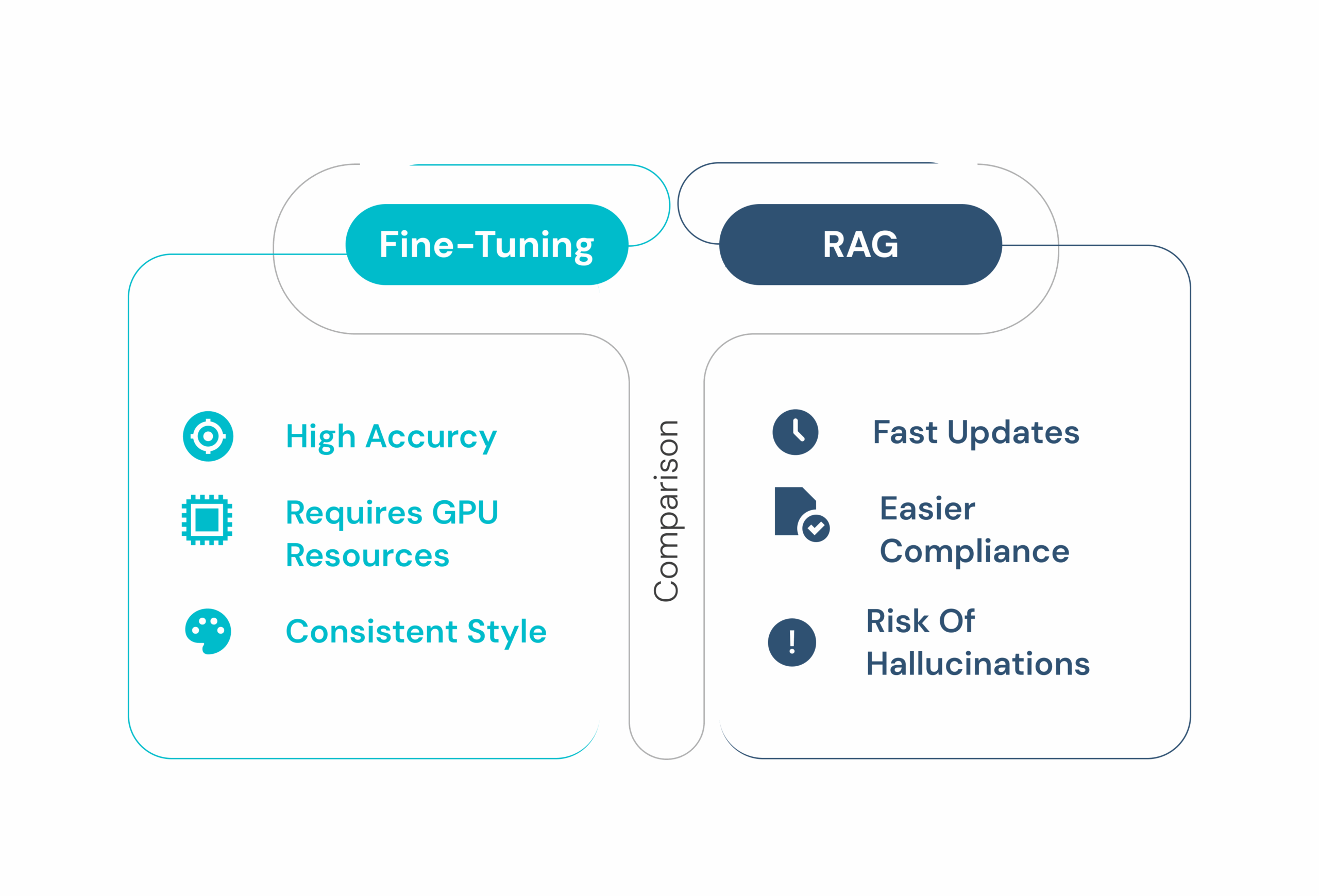
    While RAG excels at injecting facts, it has limitations:

    • It can’t teach the model how to reason.
    • It doesn’t enforce stylistic consistency.
    • And when retrieval fails, hallucinations creep in.

    That’s your cue: when structure, tone, or deterministic behavior become priorities or when retrieved content isn’t enough to answer correctly, you transition to fine-tuning.

    Enter Fine-Tuning: Precision with Permanence

    Fine-tuning involves retraining the base model on your domain-specific data, embedding domain-specific language, decision logic, and formatting directly into its parameters.

    This is essential when:

    • You want consistent behavioral patterns (e.g., legal summaries, medical reports).
    • You need high accuracy where the retrieval is partially optimal or completely absent.
    • Your workflows involve fixed taxonomies or templates.
    • Hallucination pt.

    Fine-tuning embeds knowledge deep into the model for deterministic output.

    Build Both With DataNeuron Without Building Infrastructure

    Unlike fragmented ML stacks, DataNeuron lets you orchestrate RAG and fine-tuning in a single interface. Most platforms force teams to juggle disconnected tools just to get a basic RAG or fine-tuning pipeline running. DataNeuron changes that.

    • Unified no-code interface to design, chain, and orchestrate both RAG and fine-tuning workflows without DevOps dependency
    • DSEAL powered Dataset Curation to automatically generate high-quality, diverse datasets, structured and ready for fine-tuning with minimal manual prep
    • Built-in prompt design tools to help structure and adapt inputs for both generation and retrieval use cases
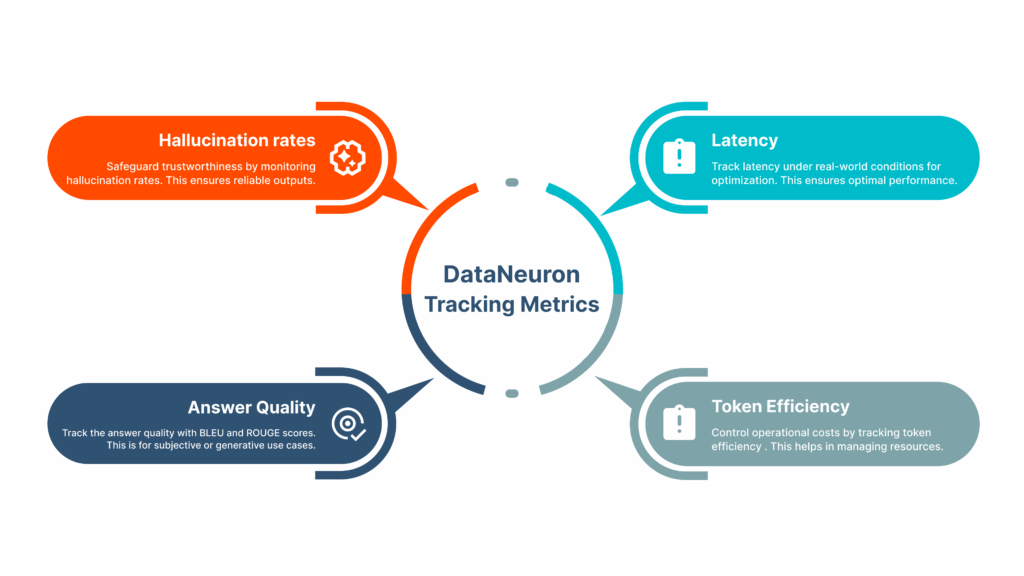
    • Robust evaluation system that supports multi-layered, continuous testing spanning BLEU/ROUGE scoring, hallucination tracking, and relevance validation, ensuring quality improves over time
    • Versioned model tracking and performance comparison across iterations, helping teams refine workflows based on clear, measurable outcomes

    Use DataNeuron to monitor and iterate across both workflows. 

    1. Fine-tune the LLM for tone, structure, and in-domain reasoning.
    2. Layer in RAG to supply the most recent facts or data points.

    This hybrid pattern ensures that your AI communicates reliably and stays up to date.

    These metrics help ensure both your fine-tuned and RAG-based pipelines stay grounded, efficient, and aligned with real-world expectations.

    Start Smart with DataNeuron

    • A customer support team used fine-tuning on 10,000 Q&A pairs and cut error rates by 40%.
    • A public sector client layered RAG into live deployments across 50+ policies, with no retraining needed.

    Both teams used the same platform. One interface. Multiple workflows. Wherever you are in your AI journey, DataNeuron gets you moving quickly.

  • Streamlining Support Operations with DataNeuron’s LLM Routing Solution

    Streamlining Support Operations with DataNeuron’s LLM Routing Solution

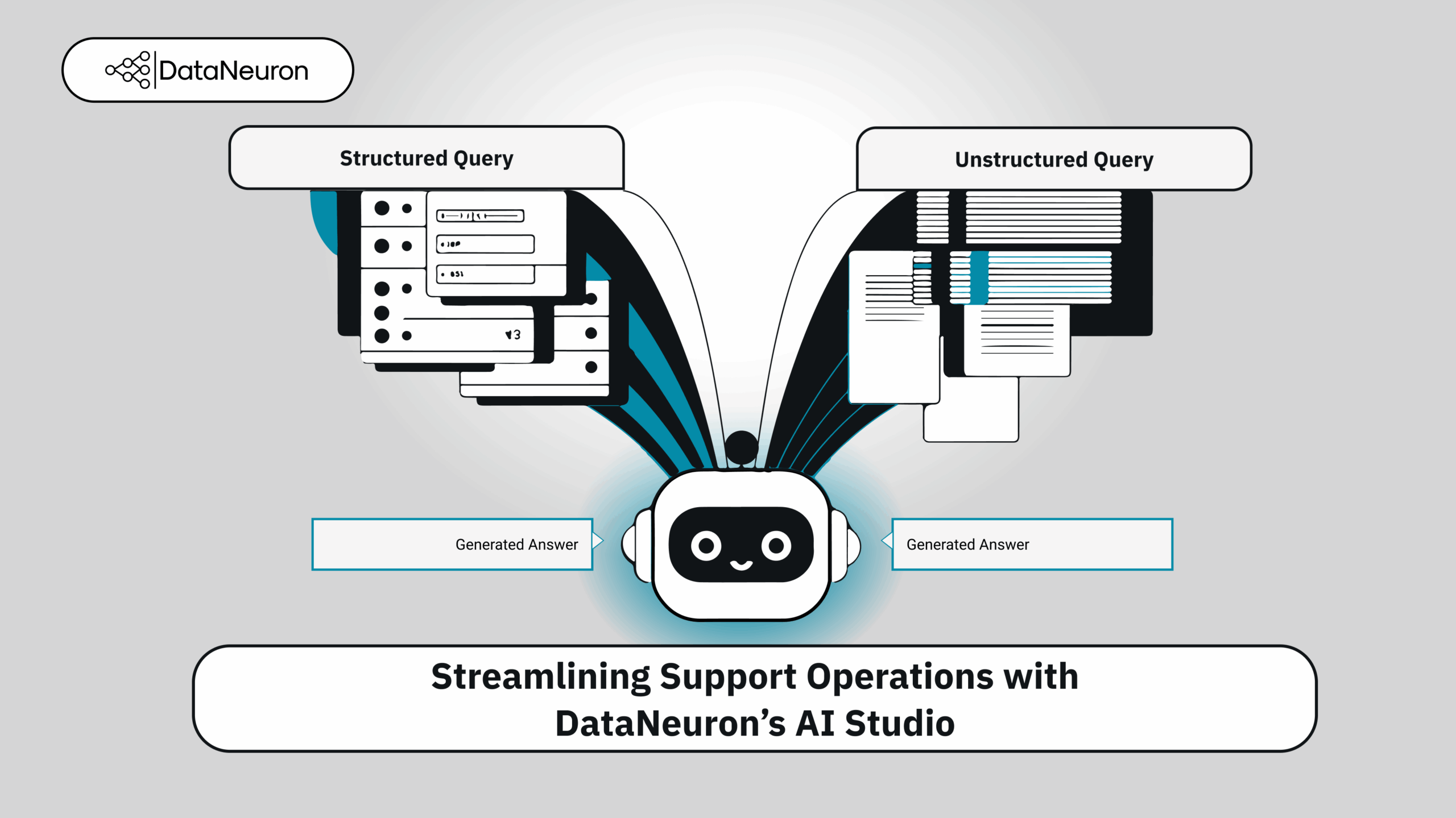
    A leading D2C business in India and international markets, renowned for its home and sleep products, aimed to enhance customer support. As a major retailer of furniture, mattresses, and home furnishings, they faced a major challenge: inefficiency in handling a high volume of diverse customer inquiries about product details, order status, and policies, resulting in slow response times and customer frustration. The company required a solution capable of understanding and responding to definitive customer queries, an area where existing chatbot solutions had fallen short.

    The DataNeuron Solution: Smart Query Handling with LLM Studio

    To solve this, the team implemented a smart, hybrid retrieval solution using DataNeuron’s LLM Studio, built to understand and respond to diverse customer queries, regardless of how or where the data was stored.

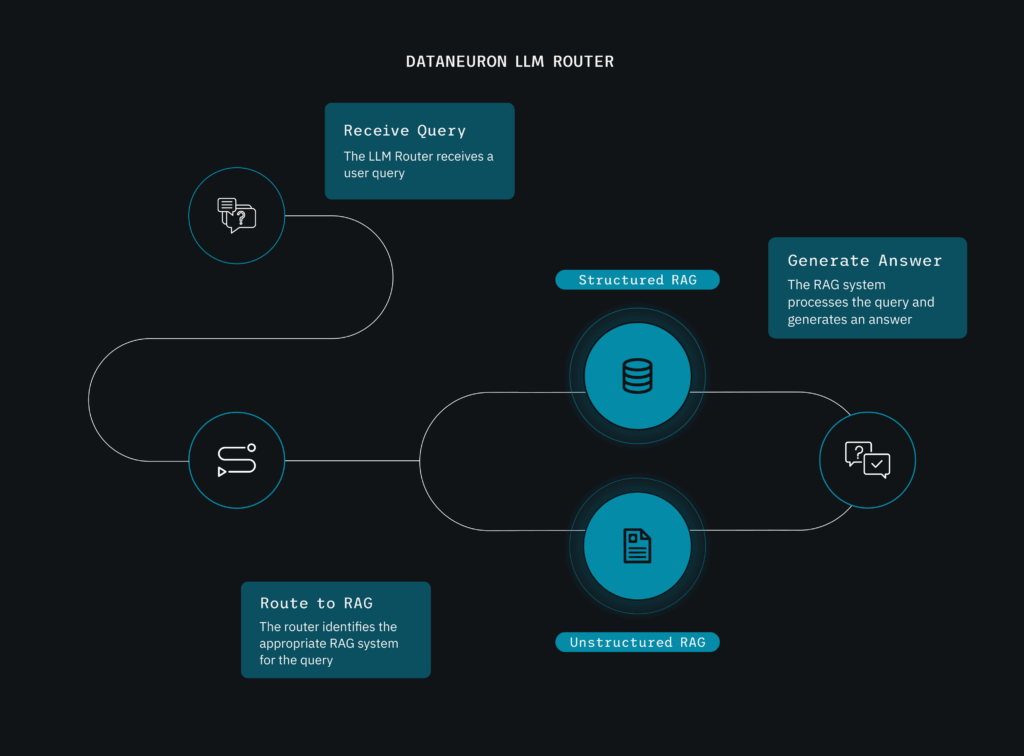
    Step 1: Intelligent Classification with the LLM Router

    The first stage was a classifier-based router that automatically determined whether a query required structured or unstructured information. For example:

    • Structured: “What is the price of a king-size bed?”
    • Unstructured: “What is the return policy if the product is damaged?”

    The router leveraged a wide set of example queries and domain-specific patterns to route incoming questions to the right processing pipeline.

    Step 2: Dual-Pipeline Retrieval Augmented Generation (RAG)

    Once classified, queries flowed into one of two specialized pipelines:

    Structured Query Pipeline: Direct Retrieval from Product Databases

    Structured queries were translated into SQL and executed directly on product databases to retrieve precise product details, pricing, availability, etc. This approach ensured fast, accurate answers to data-specific questions.

    Unstructured Query Pipeline: Semantic Search + LLM Answering

    Unstructured queries were handled via semantic vector search powered by DataNeuron’s RAG framework. Here’s how:

    • The question was converted into a vector embedding.
    • This vector was matched with the most relevant documents in the company’s vector database (e.g., policy documents, manuals).
    • The matched content was passed to a custom LLM to generate grounded, context-aware responses.

    Studio Benefits: Customization, Evaluation, and Fallbacks

    The LLMs used in both pipelines were customized via LLM Studio, which offered:

    Fallback mechanisms when classification confidence was low, such as routing queries to a human agent or invoking a hybrid LLM fallback.

    Tagging and annotation tools to refine training data.

    Built-in evaluation metrics to monitor performance.

    DataNeuron’s LLM Router, transformed our support: SQL‑powered answers for product specs and semantic search for policies now resolve 70% of tickets instantly, cutting escalations and driving our CSAT, all deployed in under two weeks.

    – Customer Testimony

    The DataNeuron Edge

    DataNeuron LLM Studio automates model tuning with:

    • Built-in tools specifically for labeling and tagging datasets.
    • LLM evaluations to compare performance before and after tweaking.

    Substantive changes introduced:

    • Specifically stated “service” and “cancellation” to address comments.
    • Highlighted the “Router capability dataset with lots of questions” to highlight the importance of data diversity for the classifier.
    • Detailed the process of the “Structure RAG” pipeline, including natural language to SQL and back to natural language.

  • Multi-Agent Systems vs. Fine-Tuned LLMs: DataNeuron’s Hybrid Perspective

    Multi-Agent Systems vs. Fine-Tuned LLMs: DataNeuron’s Hybrid Perspective

    We’ve all seen how Large Language Models (LLMs) have revolutionized tasks, from answering emails and generating code to summarizing documents and navigating chatbots. In just one year, market growth increased from $3.92 billion to $5.03 billion in 2025, driven by the transformation of customer insights, predictive analytics, and intelligent automation. 

    However, not every AI challenge can(or should) be solved with a single, monolithic model. Some problems demand a laser-focused expert LLM, customized to your precise requirements. Others call for a team of specialised models working together like humans do. 

    At DataNeuron, we recognize this distinction in your business needs and empower enterprises with both advanced fine-tuning options and flexible multi-agent systems. Let’s understand how DataNeuron’s unique offerings set a new standard.

    What is a Fine-Tuned LLM, Exactly?


    Consider adopting a general-purpose AI model and training it to master a specific activity, such as answering healthcare queries, insurance questions, or drafting legal documents. That is fine-tuning. Fine-tuning creates a single-action specialist, an LLM that consistently delivers highly accurate, domain-aligned responses. 

    Publicly available models (such as GPT-4, Claude, and Gemini) are versatile but general-purpose. They are not trained using your confidential data. Fine-tuning is how you close the gap and turn generalist LLMs into private-domain experts.

    With fine-tuning, you use private, valuable data to customize an LLM to your unique domain needs.

    • Medical information (clinical notes, patient records, and diagnostic protocols is safely handled for HIPAA/GDPR compliance.
    • Financial compliance documents
    • Legal case libraries
    • Manufacturing SOPs

    Fine-Tuning Options Offered by DataNeuron


    Parameter-Efficient Fine-Tuning: PEFT is a more efficient fine-tuning method that only changes a portion of the model’s parameters. PEFT (Prefix-Tuning for Efficient Adaptation of Pre-trained BERT) is a widely used approach with promising outcomes.

    Direct Preference Optimization: DPO aligns models to human-like preferences and ranking behaviors. Ideal for picking multiple types of responses.

    DataNeuron supports both PEFT and DPO workflows, providing scalable, enterprise-grade model customisation. These solutions enable enterprises to quickly adapt to new use cases without requiring complete model retraining. 

    If your work does not change substantially and the responses follow a predictable pattern, fine-tuning is probably your best option.

    What is a Multi-Agent System?


    Instead of one expert, you have a group of agents performing tasks in segments. One person is in charge of planning, another collects data, and another double-checks the answer. They work together to complete a task. That’s a multi-agent system, multiple LLMs (or tools) with different responsibilities that work together to handle complicated operations.

    A multi-agent system involves multiple large language models (LLMs) or tools, each with distinct responsibilities, collaborating to execute complex tasks.

    At DataNeuron, our technology is designed to allow both hierarchical and decentralized agent coordination. This implies that teams may create workflows in which agents take turns or operate simultaneously, depending on the requirements.

    Agent Roles: Planner, Retriever, Executor, and Verifier

    In a multi-agent system, individual agents are entities designed to perform specific tasks as needed. While the exact configuration of agents can be built on demand and vary depending on the complexity of the operation, some common and frequently deployed roles include:

    Planner: Acts like a project manager, responsible for defining tasks and breaking down complex objectives into manageable steps.

    Retriever: Functions as a knowledge scout, tasked with gathering necessary data from various sources such as internal APIs, live web data, or a Retrieval-Augmented Generation (RAG) layer.

    Executor: Operates as the hands-on worker, executing actions on the data based on the Planner’s instructions and the information provided by the Retriever. This could involve creating, transforming, or otherwise manipulating data.

    Verifier: Plays the role of a quality assurance specialist, ensuring the accuracy and validity of the Executor’s output by identifying discrepancies, validating findings, and raising concerns if issues are detected.

    These roles represent a functional division of labor that enables multi-agent systems to handle intricate tasks through coordinated effort. The flexibility of such systems allows for the instantiation of these or other specialized agents as the specific demands of a task dictate.

    Key Features:

    • Agents may call each other, trigger APIs, or access knowledge bases.
    • They could be specialists (like a search agent) or generalists.
    • Inspired by how individuals delegated and collaborated in teams.

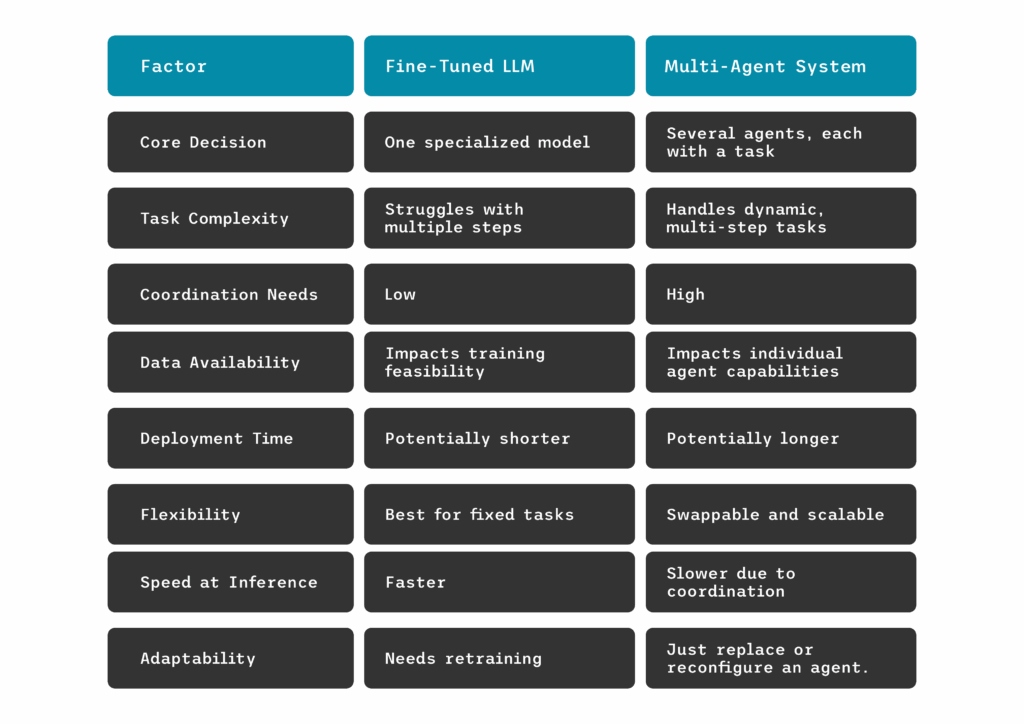
    Choosing Between Fine-Tuned LLMs and Multi-Agent Systems: What Points to Consider

    Data In-Hand

    If you have access to clean, labeled, domain-specific data, a fine-tuned LLM can generate high precision. These models thrive on well-curated datasets and learn only what you teach them.

    Multi-agent systems are better suited to data that is dispersed, constantly changing, or unstructured for typical fine-tuning. Agents such as retrievers may extract essential information from APIs, databases, or documents in real time, eliminating the need for dataset maintenance.

    Task Complexity

    Consider task complexity as the number of stages or moving pieces involved. Fine-tuned LLMs are best suited for targeted, repeated activities. You teach them once, and they continuously perform in that domain.

    However, when a job requires numerous phases, such as planning, retrieving data, checking outcomes, and initiating actions, a multi-agent method is frequently more suited. Different agents specialize and work together to manage the workflow from start to finish.

    Need for Coordination

    Fine-tuned models may be quite effective for simple reasoning, especially when the prompts are well-designed. They can use what they learnt in training to infer, summarize, or produce.

    However, multi-agent systems excel when the task necessitates more back-and-forth reasoning or layered decision-making. Before the final product goes into production, a planner agent breaks down the task, a retriever recovers information, and a validator verifies for accuracy.

    Time to Deploy

    Time is typically the biggest constraint. Fine-tuning needs some initial investment: preparing data, training the model, and validating results. It’s worth it if you know the assignment will not change frequently.

    Multi-agent systems provide greater versatility. You can assemble agents from existing components to get something useful up and running quickly. Need to make a change? Simply exchange or modify an agent; no retraining is required.

    Use Cases: Fine-Tune Vs. Multi-Agent

    The best way to grasp a complicated decision is through a few tangible stories. So here are some real-world scenarios that make the difference between fine-tuned LLMs and multi-agent systems as clear as day.

    Scenario 1: Customer Support Chatbot

    Company: HealthTech Startup

    Goal: Develop a chatbot that responds to patient queries regarding their platform.

    Approach: Fine-Tuned LLM

    They trained the model on:

    • Historical support tickets
    • Internal product documentation
    • HIPAA-compliant response templates

    Why it works: The chatbot provides responses that read on-brand, maintain compliance rules, and do not hallucinate because the model was trained in the company’s precise tone and content.

    Scenario 2: Market Research Automation

    Business: Online Brand

    Objective: Be ahead of the curve by automating product discovery.

    Approach: Multi-Agent System

    The framework includes:

    • Search Agent to crawl social media for topically relevant items
    • Sentiment and Pattern Recognition Analyzer Agent
    • Strategic Agent to advise on product launch angles

    Why it works: The system constantly monitors the marketplace, learns to adjust to evolving trends, and gives actionable insights that are free from human micromanagement.

    At DataNeuron, we built our platform to integrate fine-tuned intelligence with multi-agent collaboration. Here’s what it looks like: Various agents, both pre-built and customizable, can be used for NLP tasks like NER, document search, and RAG. Built-in agents offer convenience for common tasks, while customizable agents provide flexibility for complex scenarios by allowing fine-tuning with specific data and logic. The choice depends on task complexity, data availability, performance needs, and resources. Simple tasks may suit built-in agents, whereas nuanced tasks in specialized domains often benefit from customizable agents. Advanced RAG applications frequently necessitate customizable agents for effective information retrieval and integration from diverse sources.

    So, whether your activity is mundane or dynamically developing, you get the ideal blend of speed, scalability, and intelligence. You don’t have to pick sides. Instead, choose what best suits your business today. We are driving this hybrid future by making it simple to design AI that fits your workflow, not the other way around.