Tag: #NLP

  • The Agentic AI Toolbook: Smarter Tools for Smarter Outcomes

    The Agentic AI Toolbook: Smarter Tools for Smarter Outcomes

    For years, enterprise AI conversations have revolved around agents. The autonomous entities that plan, reason, and act. In slide decks and product pitches, the agent is portrayed as a brain: it processes inputs, makes decisions, and produces outputs. But when you peel back the layers of a real system, a different story emerges. The agent is only as powerful as the tools it can call.

    The new Agentic AI systems are expected not only to reason but also to execute. Before we talk about tools, let’s clarify what an agent really is and why, at DataNeuron, we believe the toolbook deserves just as much attention as the agent itself.

    What an Agent Really Does

    An agent handles the thinking and decision-making, while tools handle the doing. Tools perform the actual actions, such as classifying text, scraping websites, sending emails, pulling data from CRMs, or writing into dashboards. Without tools, an agent can process information but can’t take action. In short, the agent decides what needs to be done and when.

    From Reasoning to Action

    This is where the execution layer comes in. Tools translate an agent’s intent into real-world action. Crucially, the agent doesn’t have to know how each tool works internally; it only needs to know three things:

    What the tool does

    What input to give it

    What output to expect

    This clean separation of reasoning (agent) and execution (tools) keeps systems modular, interpretable, and easy to govern. You can upgrade or swap out tools without retraining the agent, catering to what large enterprises need: faster iteration cycles and safer deployments.

    A Quick Scenario–Customer Support

    Suppose your AI receives the task “analyze complaints and send a summary to the team.” A traditional chatbot would try to handle everything within a single model. An agentic system built on DataNeuron does it differently:

    • Fetches customer history from the CRM using an API-based tool.
    • Classifies the complaint and extracts order IDs using DataNeuron Native Tools, such as multiclass classifiers and NER.
    • Retrieves troubleshooting steps via Structured RAG.
    • Summarizes the case with a custom tool configured by your support ops team.
    • Sends an acknowledgment using an external mail connector.

    The result is an automated pipeline that used to require manual coordination across multiple teams.

    Inside the DataNeuron Toolbook

    At DataNeuron, we built the Toolbook to make this orchestration simple and scalable. Instead of hand-coding workflows, users can select from a library of pre-built tools or define their own. Everything is callable through standard input/output schemas so that the agent can pick and mix tools without brittle integrations.

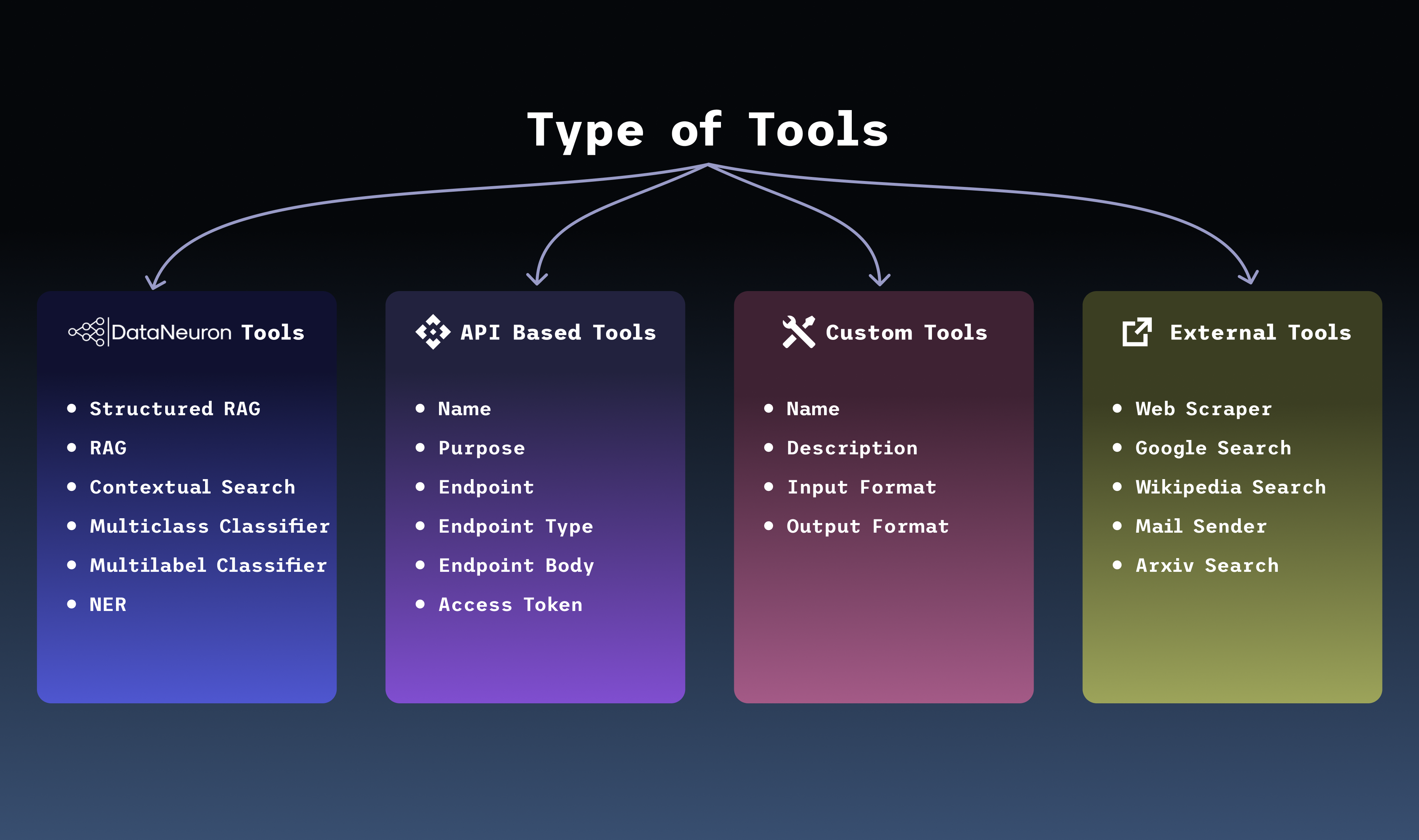
    We organize our toolbook into four pillars, each extending the agent’s reach differently.

    1. DataNeuron Native Tools

    These are our first creation in studio-high-utility, pre-configured tools optimized for AI workflows, often known as the “intelligence primitives” of your agent. They’re ready to call as soon as you deploy an agent:

    • Structured RAG (Retrieval-Augmented Generation): Combines document indexing with structured memory, letting agents pull curated data sets in real time. Ideal for regulatory documents, knowledge bases, or customer support manuals.
    • Contextual Search: Allows agents to query within a bounded knowledge base, perfect for domain-specific applications like legal, customer service, or biomedical agents.
    • Multiclass & Multilabel Classifiers: Let agents tag or categorize inputs, such as sorting customer feedback by sentiment and urgency or routing tickets to the right department.
    • Named Entity Recognition (NER): Extracts names, locations, products, and other entities, essential for parsing resumes, contracts, or customer emails.

    You don’t code these tools; you configure them. The agent calls them as needed, with predictable inputs and outputs.

    2. External Tools

    These extend the agent’s reach into the broader digital ecosystem. Think of them as bridges between your agent and the open web or third-party services. Examples include:

    • Web Scraper to pull structured data from webpages, prices, job postings, and event schedules.
    • Google, Wikipedia, and Arxiv Search for real-time knowledge retrieval, essential for summarizing or validating claims.
    • Mail Sender to automate communications, acknowledgments, follow-ups, and onboarding instructions.

    With external tools, your agent can enrich its answers, validate facts, and trigger outward-facing actions.

    3. Custom Tools

    Not every enterprise workflow fits into an off-the-shelf template. That’s why we let you create custom tools by simply defining:

    • name (e.g., “SummarizeComplaint”)
    • description (“Summarizes customer complaint emails into action items”)
    • input/output schema

    Based on this metadata, the DataNeuron platform generates a callable tool automatically. This is especially powerful in domains where business logic is unique, such as parsing health insurance claims, configuring automated compliance checks, or running internal analytics.

    You define what the tool does, not how it does it, while the system handles the integration.

    4. API-Based Tools

    These connect agents to external systems or databases, turning your AI from a smart assistant into an operational actor. You define the tool’s:

    • Name and purpose
    • API endpoint and method
    • Auth/token structure
    • Request/response format

    From there, the platform generates a tool that the agent can call. This enables workflows like:

    • Fetching real-time data from a food delivery backend.
    • Pushing recommendations into a CRM.
    • Triggering marketing campaigns.

    API-based tools let agents interact with your production systems securely and at scale.

    Let’s consider another scenario of a Digital Health Assistant

    To see how these pieces fit together, imagine a hospital deploying a digital health assistant for its doctors. A patient logs in and requests an explanation of their latest blood test report:

    • API-Based Tool fetches the patient’s lab results from the hospital’s CRM or EHR database.
    • DataNeuron Native Tools (NER + multilabel classifier + Structured RAG) extract key metrics, flag abnormal values, and pull relevant medical guidelines from an internal knowledge base.
    • Custom Tool created by the hospital’s analytics team generates a plain-language summary of the patient’s health status and next steps.
    • External Tools email the report to the patient and physician, and optionally pull the latest research articles to confirm if the doctor requests supporting evidence.

    All of this happens automatically. The agent decides the sequence of actions; each tool performs its specific function. Data is fetched, analyzed, explained, enriched with context, and delivered without the doctor or patient stitching the pieces together manually.

    Why This Matters?

    Moving from model-first to tool-first thinking turns AI from a smart assistant into an operational actor. Modular tools let agents take sequential actions toward complex goals while giving enterprises governance and flexibility: tools can be audited or swapped without altering the agent’s logic, new capabilities can be added like apps on a phone, and clear input/output schemas simplify security and compliance integration.

    The most valuable AI tool in the future won’t be the one that “knows” everything. It will be the one that knows how to get things done, and that’s exactly what the DataNeuron Agentic AI Toolbook is built for.

    At DataNeuron, we’re not trying to replace engineers, but giving them a new medium. Workflows can be designed using reusable tools, customized by intent, and executed by agents who know when and why to use them. Instead of one massive, brittle model, you get a living ecosystem where each component can evolve independently.

  • Distill & Deploy: Scalable LLMs Made Simple With DataNeuron 

    Distill & Deploy: Scalable LLMs Made Simple With DataNeuron 

    Large Language Models (LLMs) like Llama and Mistral offer immense potential, but their massive size creates deployment challenges, as slow speeds and hefty operational costs hinder their real-world applications. When building a real-time application for your enterprise or aiming for budget deployment at scale, running a 13 B+ parameter model is impractical.

    This is where model distillation comes into play.

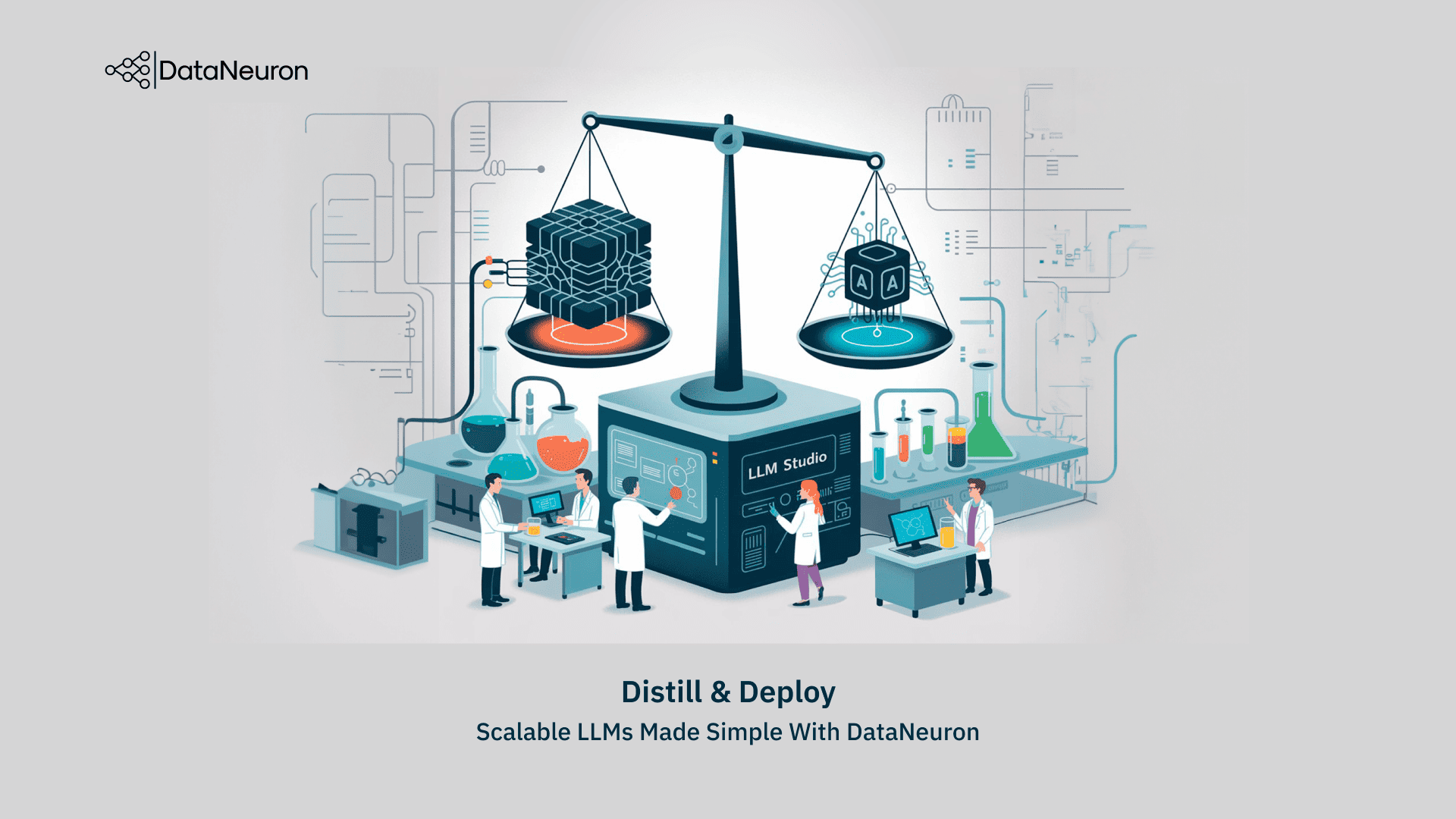
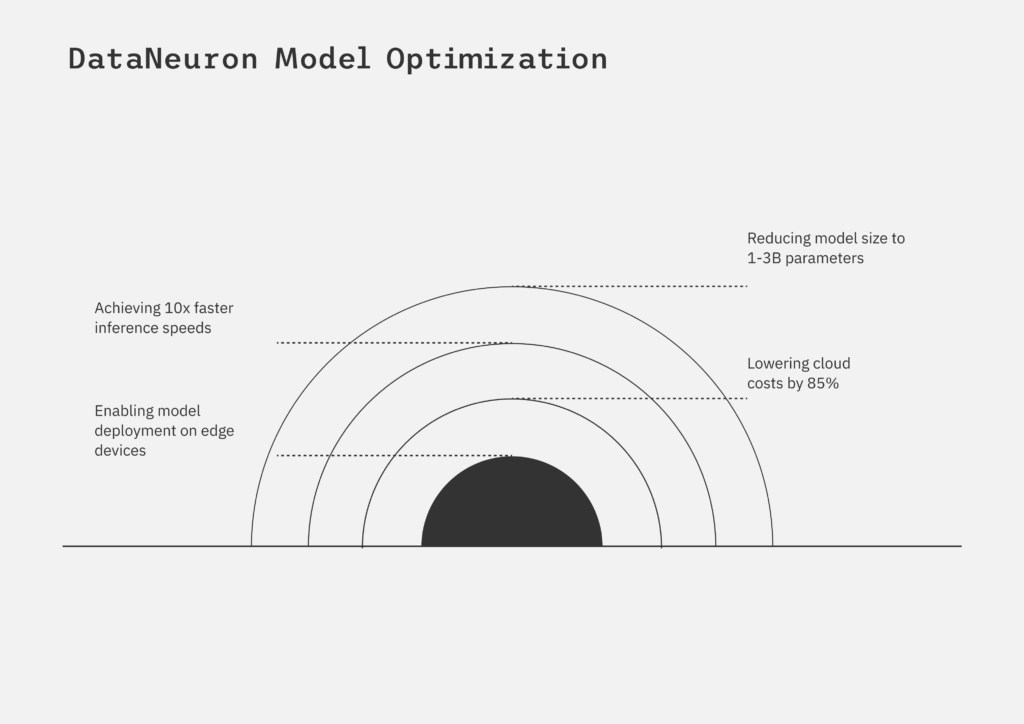
    Think of it as extracting the core wisdom of a highly knowledgeable “teacher” model and transferring it to a smaller, more agile “student” model. At DataNeuron, we’re revolutionizing this process with our LLM Studio. Our platform boasts a smooth workflow that integrates intelligent data curation with a powerful distillation engine that delivers:

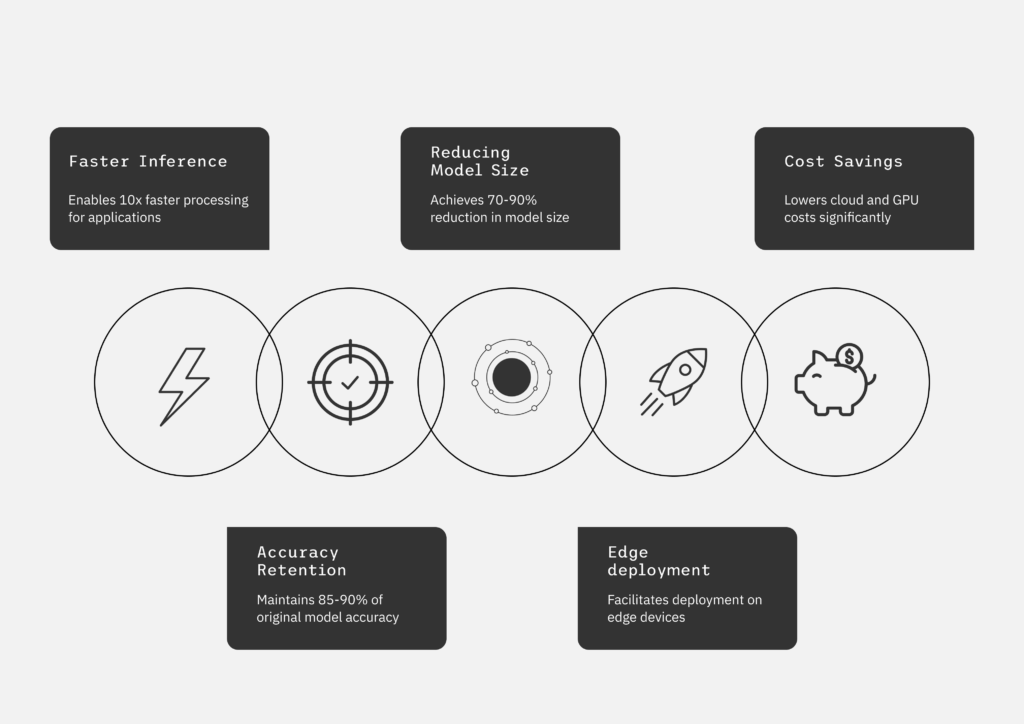
    • Up to 10X faster inference speed*
    • 90% reduction in model size*
    • Significant cost 
    • Saving on GPU infrastructure
    • High accuracy retention

    Why is Distillation a Game Changer?

    Deploying billion-parameter LLMs to production introduces four major bottlenecks:

    1. Latency: A few seconds of latency to produce responses from big models is not suitable for real-time use in conversational AI, customer, and real-time interactions
    2. Infrastructure Cost: LLMs are GPU-intensive. Executing one inference on a +13B model doesn’t sound like much until you are dealing with thousands of simultaneous users. Your cloud expenses surge quickly. A 13B parameter model might end up costing 5X more to execute than a distilled 2B version.
    3. Infrastructure Demand: Scaling mass models necessitates more powerful GPUs, scaled serving infrastructure, and continuous performance tuning. Deployment on devices becomes infeasible when model sizes exceed 5B parameters.
    4. Hallucinations: Larger models are more likely to produce inapt or irrelevant answers without proper tuning.

    Model distillation removes these limitations by transferring the “knowledge” from a large (teacher) model (e.g., Llama 13B) to a smaller (student) model (e.g., a Llama 1B), retaining performance but vastly improving efficiency. 

    Navigating the Pitfalls of Traditional Distillation

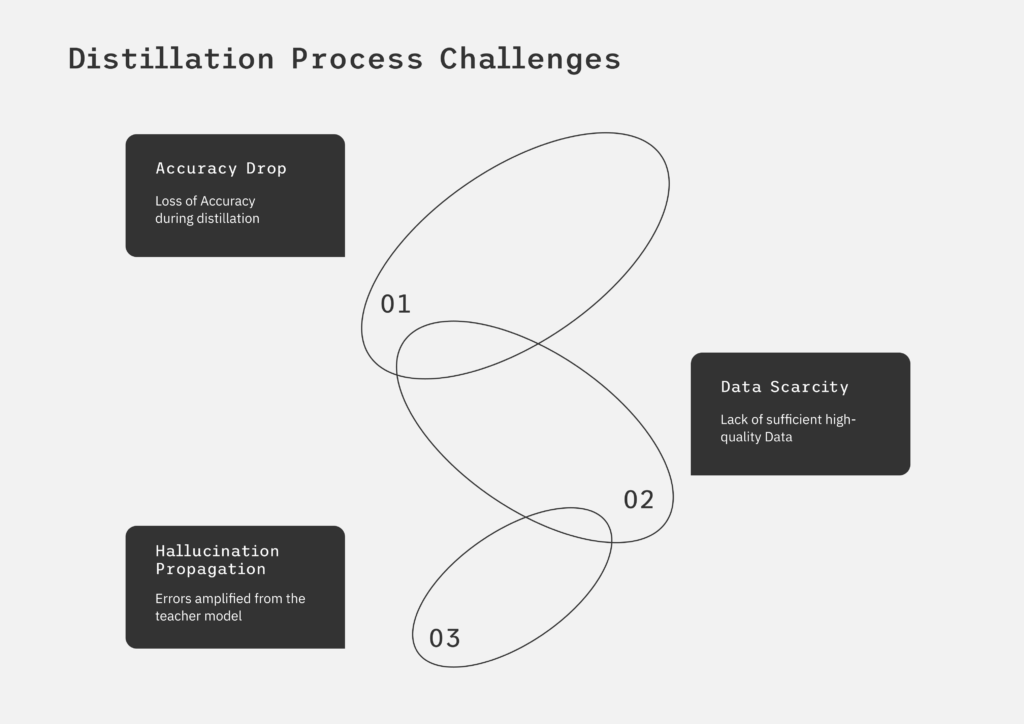
    Traditional model distillation trains a smaller “student” model to mimic a larger “teacher” by matching their outputs. While conceptually simple, valuable distillation is complex, involving careful data selection, proper loss functions (typically based on the teacher’s probability distributions for richer information transfer), and iterative testing with hyperparameters. For example, distilling a large language model for mobile deployment involves training a smaller model on relevant text, possibly incorporating the teacher’s predicted word probabilities to capture style variations.

    Without the right tools and technology to manage this complexity, the process can be time-consuming, error-prone, and difficult to scale, limiting the practical implementation of this efficiency-boosting technique.

    How is DataNeuron Doing Things Differently?

    LLM Studio allows you to easily design and manage lightweight, powerful models as per your needs. Our approach promotes intelligent data curation as the foundation for successful information transfer.

    Here’s how we streamline the process: 

    1. Data Selection with Divisive Sampling (D-SEAL) 

    We deploy our proprietary Divisive Sampling (D-SEAL) system to choose the most informative training data. D-SEAL groups comparable data points, ensuring that your student model learns from a diverse range of examples relevant to its target domain. This curated dataset, potentially built using prompts and responses generated by Retrieval-Augmented Generation (RAG), serves as the bedrock for effective distillation.

    For a detailed read, head to the NLP article on D-SEAL

    2. Intuitive Model Selection 

    Our platform features a user-friendly interface for knowledge distillation. You can easily select the Teacher Model available on the DataNeuron platform, such as a suitable high-performing model like Llama 2 70 B.

    For the Student Model, you have flexible parameter options to tailor the distilled output to your deployment requirements. Choose from the DataNeuron provided options such as Llama 2 1B, Llama 2 3B, or Llama 2 13B parameters, balancing model size, computational cost, and performance. These options allow you to optimize for various deployment environments.

    3. Distillation Engine

    The heart of LLM Studio is our powerful distillation engine, which transfers knowledge from the selected teacher model to the smaller student model. The platform handles the underlying complications, allowing you to focus on your desired outcome.

    4. Inference & Deployment 

    Once the distillation process is complete, LLM Studio allows for rapid lean model testing, evaluation, and deployment. You can easily export them for on-device use, integrate them using an API, or deploy them within your cloud infrastructure.

    DataNeuron: Beyond Just Smaller Model

    At DataNeuron, distillation does more than just shrinking the model size; we create smarter, cost-efficient, and universally deployable AI solutions. 

    Real-World Impact: Distillation In Action

    Internal Search & RAG on a Budget

    Such distilled models can still be used to power an internal search capable of domain-specific answering, effectively implemented on a modest cloud setting.

    Why Distillation Is The Future of Scalable AI

    As foundation models grow in size, competence, and cost, businesses must address the main challenge of scaling their AI applications economically. Model distillation provides an attractive and accessible way ahead.

    With DataNeuron LLM Studio, that path is no longer just for field experts and infrastructure engineers. Whether you’re working on mobile apps, internal tools, or public NLP-facing products, training, distilling, and deploying LLMs is simple when you’re associated with us. Smarter models. Smaller footprints. All made easy by DataNeuron.

    Ready to see it in action? Book a demo or go through our product walkthrough.

  • Multi-Agent Systems vs. Fine-Tuned LLMs: DataNeuron’s Hybrid Perspective

    Multi-Agent Systems vs. Fine-Tuned LLMs: DataNeuron’s Hybrid Perspective

    We’ve all seen how Large Language Models (LLMs) have revolutionized tasks, from answering emails and generating code to summarizing documents and navigating chatbots. In just one year, market growth increased from $3.92 billion to $5.03 billion in 2025, driven by the transformation of customer insights, predictive analytics, and intelligent automation. 

    However, not every AI challenge can(or should) be solved with a single, monolithic model. Some problems demand a laser-focused expert LLM, customized to your precise requirements. Others call for a team of specialised models working together like humans do. 

    At DataNeuron, we recognize this distinction in your business needs and empower enterprises with both advanced fine-tuning options and flexible multi-agent systems. Let’s understand how DataNeuron’s unique offerings set a new standard.

    What is a Fine-Tuned LLM, Exactly?


    Consider adopting a general-purpose AI model and training it to master a specific activity, such as answering healthcare queries, insurance questions, or drafting legal documents. That is fine-tuning. Fine-tuning creates a single-action specialist, an LLM that consistently delivers highly accurate, domain-aligned responses. 

    Publicly available models (such as GPT-4, Claude, and Gemini) are versatile but general-purpose. They are not trained using your confidential data. Fine-tuning is how you close the gap and turn generalist LLMs into private-domain experts.

    With fine-tuning, you use private, valuable data to customize an LLM to your unique domain needs.

    • Medical information (clinical notes, patient records, and diagnostic protocols is safely handled for HIPAA/GDPR compliance.
    • Financial compliance documents
    • Legal case libraries
    • Manufacturing SOPs

    Fine-Tuning Options Offered by DataNeuron


    Parameter-Efficient Fine-Tuning: PEFT is a more efficient fine-tuning method that only changes a portion of the model’s parameters. PEFT (Prefix-Tuning for Efficient Adaptation of Pre-trained BERT) is a widely used approach with promising outcomes.

    Direct Preference Optimization: DPO aligns models to human-like preferences and ranking behaviors. Ideal for picking multiple types of responses.

    DataNeuron supports both PEFT and DPO workflows, providing scalable, enterprise-grade model customisation. These solutions enable enterprises to quickly adapt to new use cases without requiring complete model retraining. 

    If your work does not change substantially and the responses follow a predictable pattern, fine-tuning is probably your best option.

    What is a Multi-Agent System?


    Instead of one expert, you have a group of agents performing tasks in segments. One person is in charge of planning, another collects data, and another double-checks the answer. They work together to complete a task. That’s a multi-agent system, multiple LLMs (or tools) with different responsibilities that work together to handle complicated operations.

    A multi-agent system involves multiple large language models (LLMs) or tools, each with distinct responsibilities, collaborating to execute complex tasks.

    At DataNeuron, our technology is designed to allow both hierarchical and decentralized agent coordination. This implies that teams may create workflows in which agents take turns or operate simultaneously, depending on the requirements.

    Agent Roles: Planner, Retriever, Executor, and Verifier

    In a multi-agent system, individual agents are entities designed to perform specific tasks as needed. While the exact configuration of agents can be built on demand and vary depending on the complexity of the operation, some common and frequently deployed roles include:

    Planner: Acts like a project manager, responsible for defining tasks and breaking down complex objectives into manageable steps.

    Retriever: Functions as a knowledge scout, tasked with gathering necessary data from various sources such as internal APIs, live web data, or a Retrieval-Augmented Generation (RAG) layer.

    Executor: Operates as the hands-on worker, executing actions on the data based on the Planner’s instructions and the information provided by the Retriever. This could involve creating, transforming, or otherwise manipulating data.

    Verifier: Plays the role of a quality assurance specialist, ensuring the accuracy and validity of the Executor’s output by identifying discrepancies, validating findings, and raising concerns if issues are detected.

    These roles represent a functional division of labor that enables multi-agent systems to handle intricate tasks through coordinated effort. The flexibility of such systems allows for the instantiation of these or other specialized agents as the specific demands of a task dictate.

    Key Features:

    • Agents may call each other, trigger APIs, or access knowledge bases.
    • They could be specialists (like a search agent) or generalists.
    • Inspired by how individuals delegated and collaborated in teams.

    Choosing Between Fine-Tuned LLMs and Multi-Agent Systems: What Points to Consider

    Data In-Hand

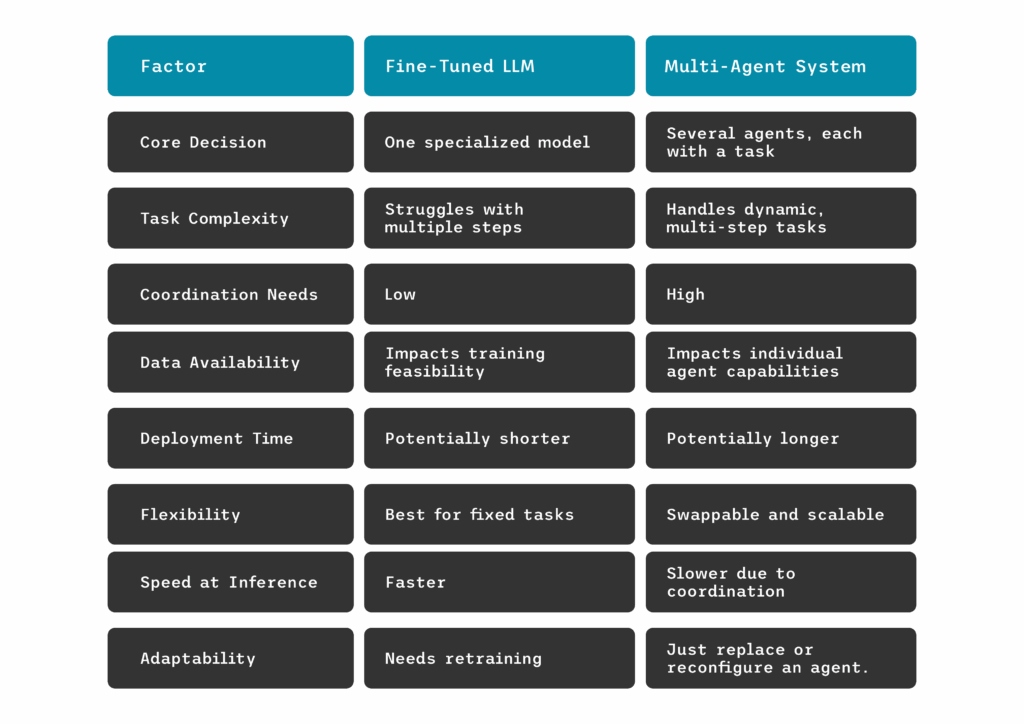
    If you have access to clean, labeled, domain-specific data, a fine-tuned LLM can generate high precision. These models thrive on well-curated datasets and learn only what you teach them.

    Multi-agent systems are better suited to data that is dispersed, constantly changing, or unstructured for typical fine-tuning. Agents such as retrievers may extract essential information from APIs, databases, or documents in real time, eliminating the need for dataset maintenance.

    Task Complexity

    Consider task complexity as the number of stages or moving pieces involved. Fine-tuned LLMs are best suited for targeted, repeated activities. You teach them once, and they continuously perform in that domain.

    However, when a job requires numerous phases, such as planning, retrieving data, checking outcomes, and initiating actions, a multi-agent method is frequently more suited. Different agents specialize and work together to manage the workflow from start to finish.

    Need for Coordination

    Fine-tuned models may be quite effective for simple reasoning, especially when the prompts are well-designed. They can use what they learnt in training to infer, summarize, or produce.

    However, multi-agent systems excel when the task necessitates more back-and-forth reasoning or layered decision-making. Before the final product goes into production, a planner agent breaks down the task, a retriever recovers information, and a validator verifies for accuracy.

    Time to Deploy

    Time is typically the biggest constraint. Fine-tuning needs some initial investment: preparing data, training the model, and validating results. It’s worth it if you know the assignment will not change frequently.

    Multi-agent systems provide greater versatility. You can assemble agents from existing components to get something useful up and running quickly. Need to make a change? Simply exchange or modify an agent; no retraining is required.

    Use Cases: Fine-Tune Vs. Multi-Agent

    The best way to grasp a complicated decision is through a few tangible stories. So here are some real-world scenarios that make the difference between fine-tuned LLMs and multi-agent systems as clear as day.

    Scenario 1: Customer Support Chatbot

    Company: HealthTech Startup

    Goal: Develop a chatbot that responds to patient queries regarding their platform.

    Approach: Fine-Tuned LLM

    They trained the model on:

    • Historical support tickets
    • Internal product documentation
    • HIPAA-compliant response templates

    Why it works: The chatbot provides responses that read on-brand, maintain compliance rules, and do not hallucinate because the model was trained in the company’s precise tone and content.

    Scenario 2: Market Research Automation

    Business: Online Brand

    Objective: Be ahead of the curve by automating product discovery.

    Approach: Multi-Agent System

    The framework includes:

    • Search Agent to crawl social media for topically relevant items
    • Sentiment and Pattern Recognition Analyzer Agent
    • Strategic Agent to advise on product launch angles

    Why it works: The system constantly monitors the marketplace, learns to adjust to evolving trends, and gives actionable insights that are free from human micromanagement.

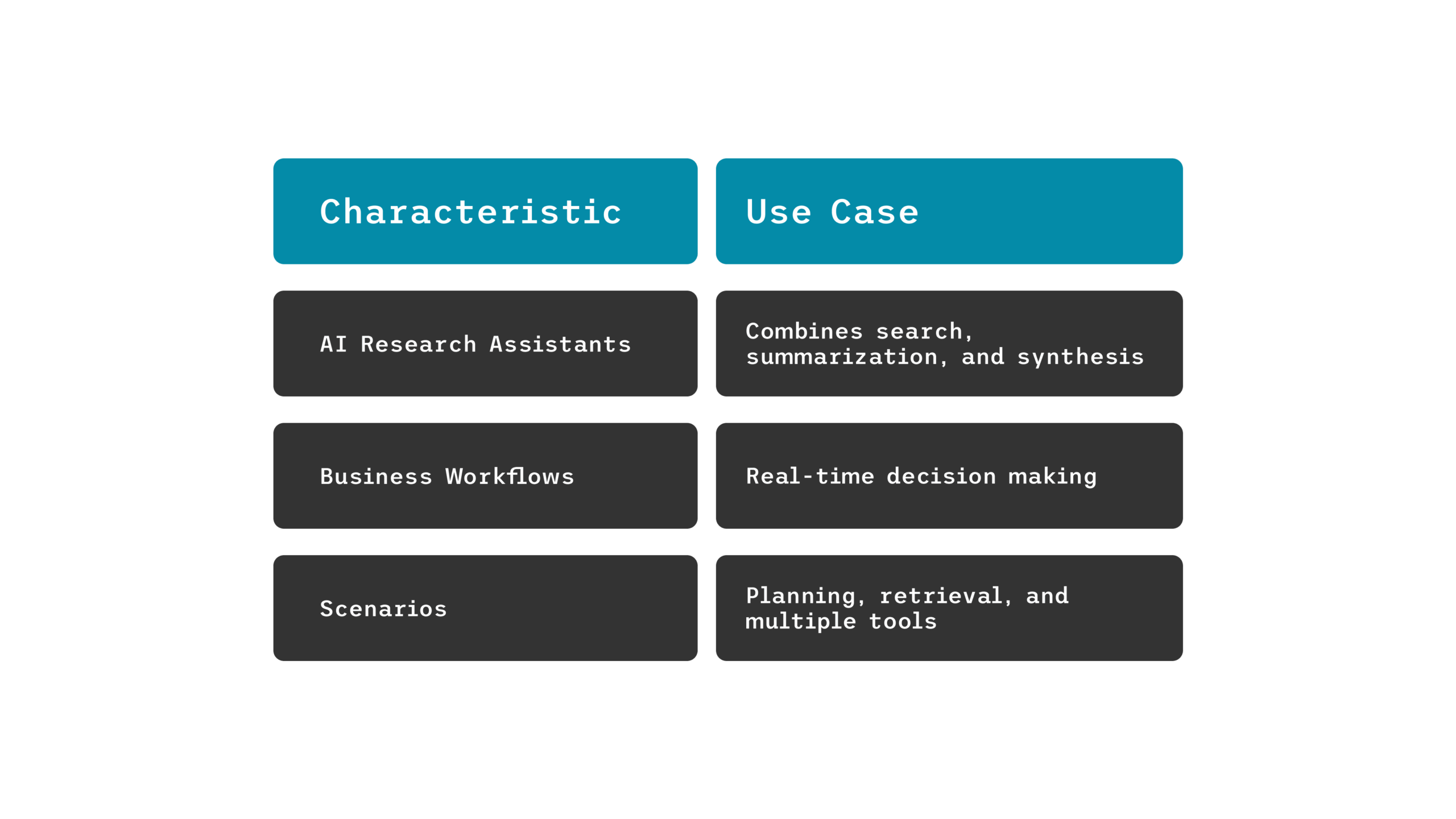
    At DataNeuron, we built our platform to integrate fine-tuned intelligence with multi-agent collaboration. Here’s what it looks like: Various agents, both pre-built and customizable, can be used for NLP tasks like NER, document search, and RAG. Built-in agents offer convenience for common tasks, while customizable agents provide flexibility for complex scenarios by allowing fine-tuning with specific data and logic. The choice depends on task complexity, data availability, performance needs, and resources. Simple tasks may suit built-in agents, whereas nuanced tasks in specialized domains often benefit from customizable agents. Advanced RAG applications frequently necessitate customizable agents for effective information retrieval and integration from diverse sources.

    So, whether your activity is mundane or dynamically developing, you get the ideal blend of speed, scalability, and intelligence. You don’t have to pick sides. Instead, choose what best suits your business today. We are driving this hybrid future by making it simple to design AI that fits your workflow, not the other way around.