Tag: #MCP

  • A2A:  The Rulebook Governing Multi-Agent Collaboration

    A2A:  The Rulebook Governing Multi-Agent Collaboration

    If the internet allowed everyone to send data, but there were no rules (like HTTP, TCP/IP, or DNS) on how to format, interpret, or verify it. One site would send text as images, another as binary, and another with no headers. You could connect, but you’d rarely understand what was sent. That’s what MAS looks like without A2A (Agent-to-Agent Protocol)

    The Model Context Protocol (MCP) gives multi-agent systems (MAS) a shared communication channel. A2A provides the contractual rules of interaction, making them reliable enough for enterprise and cross-organizational use.

    Why Multi-Agent Systems Struggle Without A2A

    Even with a strong communication layer (MCP), MAS still face critical shortcomings when there’s no governing protocol like A2A:

    • Ambiguity of meaning
    • Lack of trust 
    • Security vulnerabilities 
    • Compliance gaps
    • Cross-boundary failures 

    In short, without A2A, multi-agent systems remain prone to misalignment and unsuitable for real-world enterprise environments.

    How A2A Works

    A2A operates through a set of principles that bring clarity and governance to MAS:

    1. Structured Messages
      Every message comes with a strict schema with defined types, context, and intent, so ambiguity is removed.
    2. Authentication & Trust
      Messages can be cryptographically signed, allowing agents to verify the sender’s identity and authority.
    3. Validation Rules
      Before acting, agents validate whether a message conforms to agreed-upon standards.
    4. Governance Layer
      A2A encodes rules of interaction: who can do what, under what conditions, and with what accountability.
    5. Cross-Boundary Collaboration
      Agents across organizations or domains can work together without being tightly coupled, thanks to standardized contracts.

    A2A in Action: 
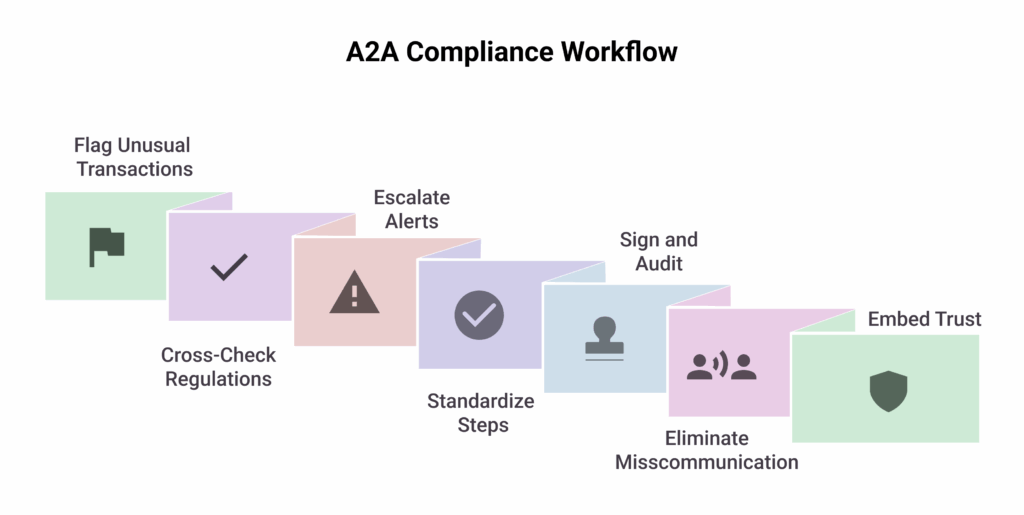
    With A2A, every step is standardized, signed, and auditable. 

    By building A2A into our platform, we ensure that agent-to-agent communication isn’t just possible, but governed and reliable. This approach helps organizations:

    • Operate multi-department workflows with confidence.
    • Collaborate securely with external vendors’ agents.
    • Maintain compliance without adding manual oversight.

    Our mission is to make MAS not only intelligent but also accountable. A2A is the step that makes that possible.

    Why A2A Shapes the Future of Agentic AI

    Looking ahead, we believe A2A will define how agent ecosystems evolve in three key ways:

    1. Governed Autonomy
      Agents won’t just act independently; they’ll act within enforceable rules and standards.
    2. Cross-Organizational Collaboration
      As businesses connect agents across ecosystems, A2A will be the “link language” that ensures safe cooperation.
    3. Trusted Intelligence
      Enterprises will demand explainable, auditable AI- A2A provides the contractual layer to deliver it.

    At DataNeuron, we move toward ecosystems of interoperable agents, and we believe A2A will be the reason they can do so with confidence.
  • MCP: The Communication Backbone of Multi-Agent Systems

    MCP: The Communication Backbone of Multi-Agent Systems

    AI progress has been upgraded with larger models, more parameters, and bigger datasets. This created powerful Large Language Models (LLMs), but exposed their limits: even the best models falter in multi-domain workflows, hallucinate facts, lose context, and struggle with complex coordination.

    Multi-Agent Systems (MAS) emerged to address these gaps by deploying specialized agents for tasks like summarization, search, compliance checking, and analysis. Together, they can outperform a single model but only if they work coherently. In enterprise customer support, for example, one agent may retrieve knowledge, another analyze sentiment, and a third draft a reply. Without shared context, they duplicate work, contradict each other, or miss critical data.

    The Model Context Protocol (MCP) closes this gap. It standardizes how agents exchange state, intent, and outputs, turning isolated components into a coordinated, auditable system capable of reliable multi-step outcomes at scale.

    Why Current Multi-Agent Systems Fall Short

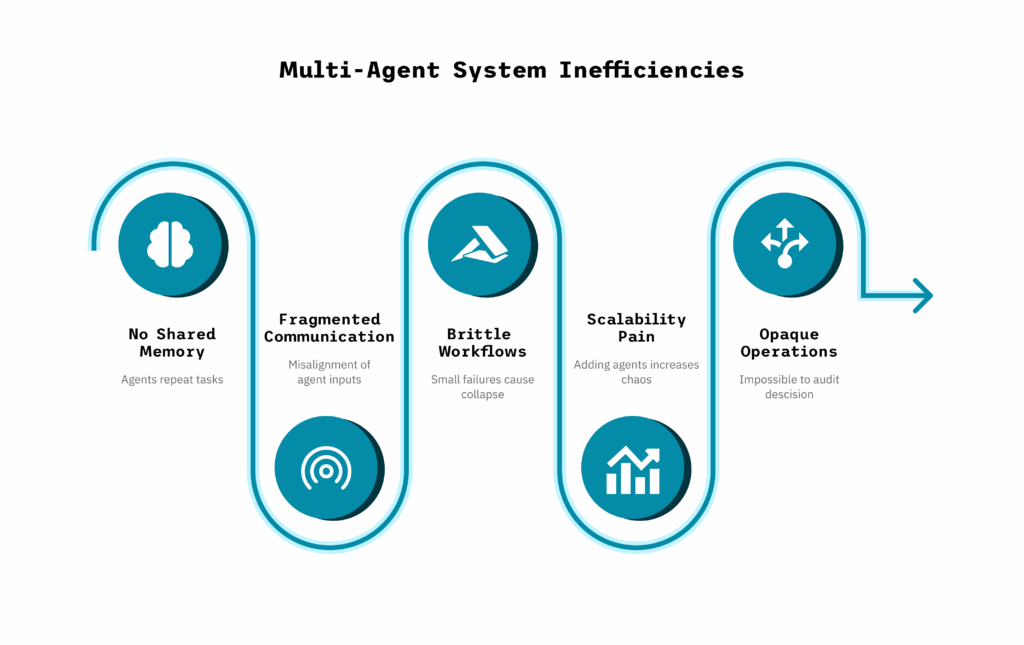
    Before understanding MCP, let’s look at what MAS misses without it:

    Today’s MAS often acts like loosely coupled tools rather than a synchronized team. The result is unpredictability, an unacceptable outcome for enterprise use cases where accuracy, compliance, and auditability matter.

    MCP: A Protocol Born of Necessity

    The Model Context Protocol (MCP) is a standardized communication framework that enables agents in a multi-agent system to “speak the same language.” Acting as both a universal translator and a message bus, MCP lets any agent, whether an LLM, retrieval engine, API connector, or compliance checker, exchange context reliably and consistently.

    How MCP Works

    At its core, MCP provides five foundational capabilities:

    • Standardized Messaging
    • Shared Memory Access
    • Publish/Subscribe Coordination
    • Dynamic Composi tion 
    • Medium-Agnostic Transport

    How would this work in Financial Compliance?

    Consider a bank’s compliance workflow:

    One agent ingests regulatory documents.

    Another checks transactions against relevant rules.

    A third summarizes the findings for auditors.

      With MCP, the pipeline is traceable, resilient, and composable: each agent publishes standardized outputs into a shared context, while downstream agents subscribe and act on verified data.

      MCP in Action at DataNeuron

      At DataNeuron, MCP is treated as the connective tissue of intelligent automation. MCP lets them expose functionality via an HTTP server, a studio server, or a custom API and register it under the MCP schema. From that moment, MCP handles orchestration: routing intent, synchronizing state, and coordinating workflows.

      This design allows us to:

      Integrate LLMs with retrieval engines and domain-specific APIs seamlessly.

      Orchestrate cross-departmental workflows without losing auditability.

      Scale agent ecosystems without creating central bottlenecks.

      By formalizing how agents communicate and share context, MCP converts fragmented tools into a unified, auditable, and scalable multi-agent system ready for real-world deployment.

      Why MCP Is Foundational to the Next Wave of Agentic AI

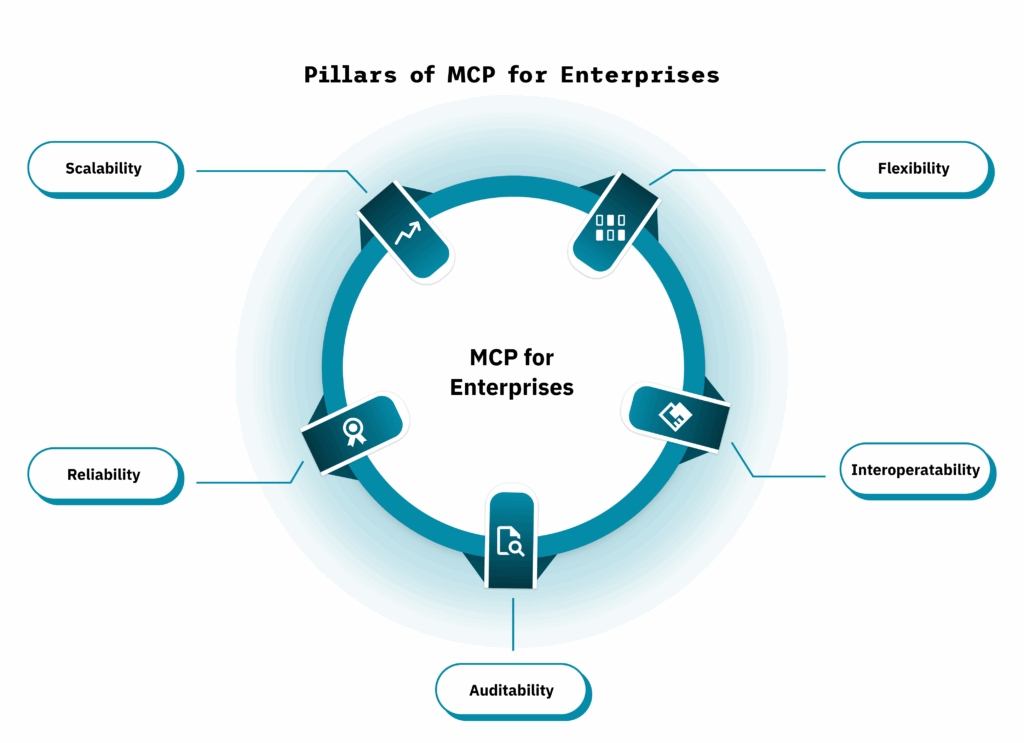
      Enterprise AI is moving away from monolithic, one-size-fits-all models toward modular, composable systems. In this new architecture, the MCP functions as the critical communication backbone, allowing intelligent agents to coordinate, adapt, and scale reliably.

      By standardizing how context, state, and intent flow between agents, MCP lays the groundwork for future-proof AI ecosystems. Three shifts illustrate this impact:

      Composable Intelligence

      Governed Autonomy 

      Cross-Ecosystem Interoperability 

      Taken together, these shifts position MCP as a cornerstone of scalable, auditable, and future-ready multi-agent systems. MCP is the infrastructure layer that enables businesses to design AI workflows that are as dynamic and trustworthy as the environments in which they operate.