Tag: #DPO

  • Beyond the “Looks Good to Me”: Why LLM Evals Are Your New Best Friend

    Beyond the “Looks Good to Me”: Why LLM Evals Are Your New Best Friend

    As large language models transition from lab experiments to real-world applications, the way we evaluate their performance must evolve. A casual thumbs-up after scanning a few outputs might be fine for a weekend project, but it doesn’t scale when users depend on models for accuracy, fairness, and reliability.

    LLM evaluations or evals do this job for you. They turn subjective impressions into structured, repeatable measurements. More precisely, evals transform the development process from intuition-driven tinkering into evidence-driven engineering, a shift that’s essential if we want LLMs to be more than just impressive demos.

    The Eval-Driven Development Cycle: Train, Evaluate, Repeat 

    At DataNeuron, evaluation (Eval) is the core of our fine-tuning process. We follow a 5-step, iterative loop designed to deliver smarter, domain-aligned models:

    1. Raw Docs

    The process starts with task definition. Whether you’re building a model for summarization, classification, or content generation, we first collect raw, real-world data, i.e., support tickets, reviews, emails, and chats, directly from your business context.

    2. Curated Evals

    We build specialized evaluation datasets distinct from the training data. These datasets are crafted to test specific capabilities using diverse prompts, edge cases, and real-world scenarios, ensuring relevance and rigor.

    3. LLM Fine-Tune

    We fine-tune your model (LLaMA, Mistral, Gemma, etc.) using task-appropriate data and lightweight methods like PEFT or DPO, built for efficiency and performance.

    4. Eval Results

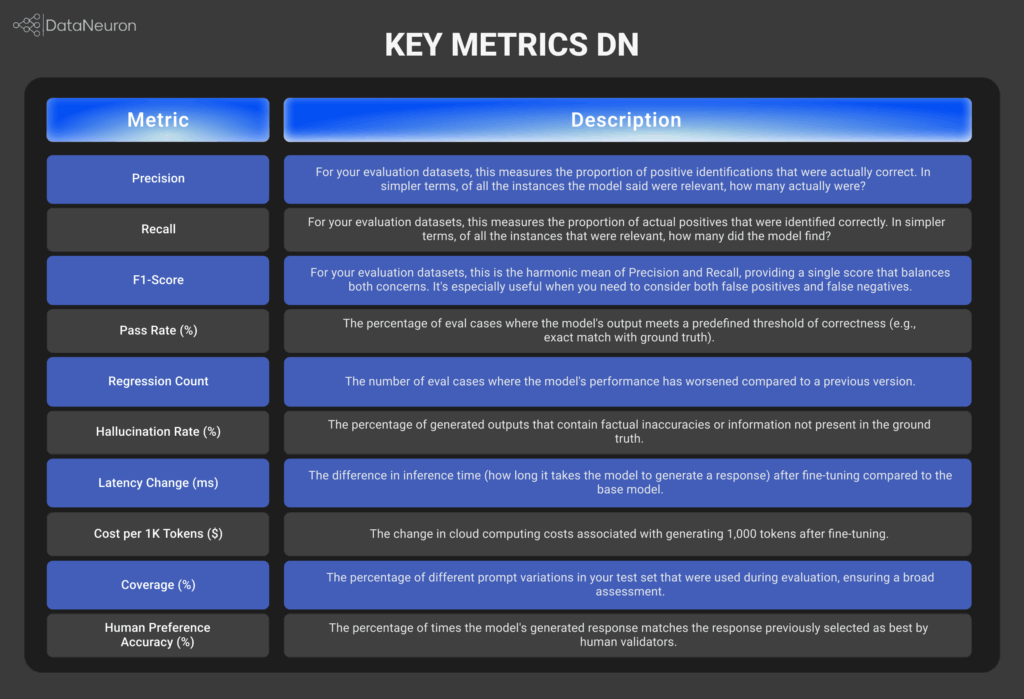
    We evaluate your model using curated prompts and subjective metrics like BLEU, ROUGE, and hallucination rate, tracking not just what the model generates, but how well it aligns with intended outcomes.

    5. Refinement Loop

    Based on eval feedback, we iterate, refining datasets, tweaking parameters, or rethinking the approach. This cycle continues until results meet your performance goals.

    Evals guide you towards better models by providing objective feedback at each stage, ensuring a more intelligent and efficient development cycle. So, what exactly goes into a robust LLM evaluation framework?

    Core Components of a Robust LLM Evaluation Framework

    Human Validation

    We recognize the invaluable role of human expertise in establishing accurate benchmarks. Our workflow enables the generation of multiple potential responses for a given prompt. Human validators then meticulously select the response that best aligns with the desired criteria. This human-approved selection serves as the definitive “gold standard” for our evaluations.

    Prompt Variations

    DataNeuron empowers users to define specific “eval contexts” and create diverse variations of prompts. This capability ensures that your model is rigorously evaluated across a broad spectrum of inputs, thereby thoroughly testing its robustness and generalization capabilities.

    Auto Tracking

    Our evaluation module automatically compares the responses generated by your fine-tuned model against the human-validated “gold standard.” This automated comparison facilitates the precise calculation of accuracy metrics and allows for the consistent tracking of how well your model aligns with human preferences. The fundamental principle here is that effective fine-tuning should lead the model to progressively generate responses that closely match those previously selected by human validators.

    Configurable Pipelines

    We prioritize flexibility and control. DataNeuron’s entire evaluation process is highly configurable, providing you with comprehensive command over every stage from data preprocessing and prompt generation to the selection of specific evaluation metrics.
    DataNeuron: Your Partner in Eval-Driven Fine-Tuning

    At DataNeuron, we’re building a comprehensive ecosystem to streamline your LLM journey, and Evals are a central piece of that puzzle. While we’re constantly evolving, here’s a glimpse of how DataNeuron empowers you with eval-driven fine-tuning:

    Core Tenets of DataNeuron’s Evaluation Methodology

    Human Validation:

    We recognize the invaluable role of human expertise in establishing accurate benchmarks. Our workflow enables the generation of multiple potential responses for a given prompt. Human validators then meticulously select the response that best aligns with the desired criteria. This human-approved selection serves as the definitive “gold standard” for our evaluations.

    Prompt Variations:

    DataNeuron empowers users to define specific “eval contexts” and create diverse variations of prompts. This capability ensures that your model is rigorously evaluated across a broad spectrum of inputs, thereby thoroughly testing its robustness and generalization capabilities.

    Auto Tracking:

    Our evaluation module automatically compares the responses generated by your fine-tuned model against the human-validated “gold standard.” This automated comparison facilitates the precise calculation of accuracy metrics and allows for the consistent tracking of how well your model aligns with human preferences. The fundamental principle here is that effective fine-tuning should lead the model to progressively generate responses that closely match those previously selected by human validators.

    Configurable Pipelines:

    We prioritize flexibility and control. DataNeuron’s entire evaluation process is highly configurable, providing you with comprehensive command over every stage from data preprocessing and prompt generation to the selection of specific evaluation metrics.

    Best Practices & Avoiding the Potholes

    Here are some hard-earned lessons to keep in mind when implementing eval-driven fine-tuning:

    Don’t Overfit to the Eval:

    Just like you can overfit your model to the training data, you can also overfit to your evaluation set. To avoid this, diversify your evaluation metrics and periodically refresh your test sets with new, unseen data.

    Beware of Eval Drift:

    The real-world data your model encounters can change over time. Ensure your evaluation datasets remain representative of this evolving reality by periodically updating them.

    Balance Latency and Quality:

    Fine-tuning can sometimes impact the inference speed of your model. Carefully consider the trade-off between improved quality and potential increases in latency, especially if your application has strict performance SLAs.

    With its focus on structured workflows and integration, DataNeuron urges users to build more reliable and effective LLM-powered applications. Moving beyond subjective assessments is crucial for unlocking the full potential of LLM fine-tuning. Evals provide the objective, data-driven insights you need to build high-performing, reliable models.

    At DataNeuron, we’re committed to making this process seamless and accessible, empowering you to fine-tune your LLMs and achieve remarkable results confidently.
  • Multi-Agent Systems vs. Fine-Tuned LLMs: DataNeuron’s Hybrid Perspective

    Multi-Agent Systems vs. Fine-Tuned LLMs: DataNeuron’s Hybrid Perspective

    We’ve all seen how Large Language Models (LLMs) have revolutionized tasks, from answering emails and generating code to summarizing documents and navigating chatbots. In just one year, market growth increased from $3.92 billion to $5.03 billion in 2025, driven by the transformation of customer insights, predictive analytics, and intelligent automation. 

    However, not every AI challenge can(or should) be solved with a single, monolithic model. Some problems demand a laser-focused expert LLM, customized to your precise requirements. Others call for a team of specialised models working together like humans do. 

    At DataNeuron, we recognize this distinction in your business needs and empower enterprises with both advanced fine-tuning options and flexible multi-agent systems. Let’s understand how DataNeuron’s unique offerings set a new standard.

    What is a Fine-Tuned LLM, Exactly?


    Consider adopting a general-purpose AI model and training it to master a specific activity, such as answering healthcare queries, insurance questions, or drafting legal documents. That is fine-tuning. Fine-tuning creates a single-action specialist, an LLM that consistently delivers highly accurate, domain-aligned responses. 

    Publicly available models (such as GPT-4, Claude, and Gemini) are versatile but general-purpose. They are not trained using your confidential data. Fine-tuning is how you close the gap and turn generalist LLMs into private-domain experts.

    With fine-tuning, you use private, valuable data to customize an LLM to your unique domain needs.

    • Medical information (clinical notes, patient records, and diagnostic protocols is safely handled for HIPAA/GDPR compliance.
    • Financial compliance documents
    • Legal case libraries
    • Manufacturing SOPs

    Fine-Tuning Options Offered by DataNeuron


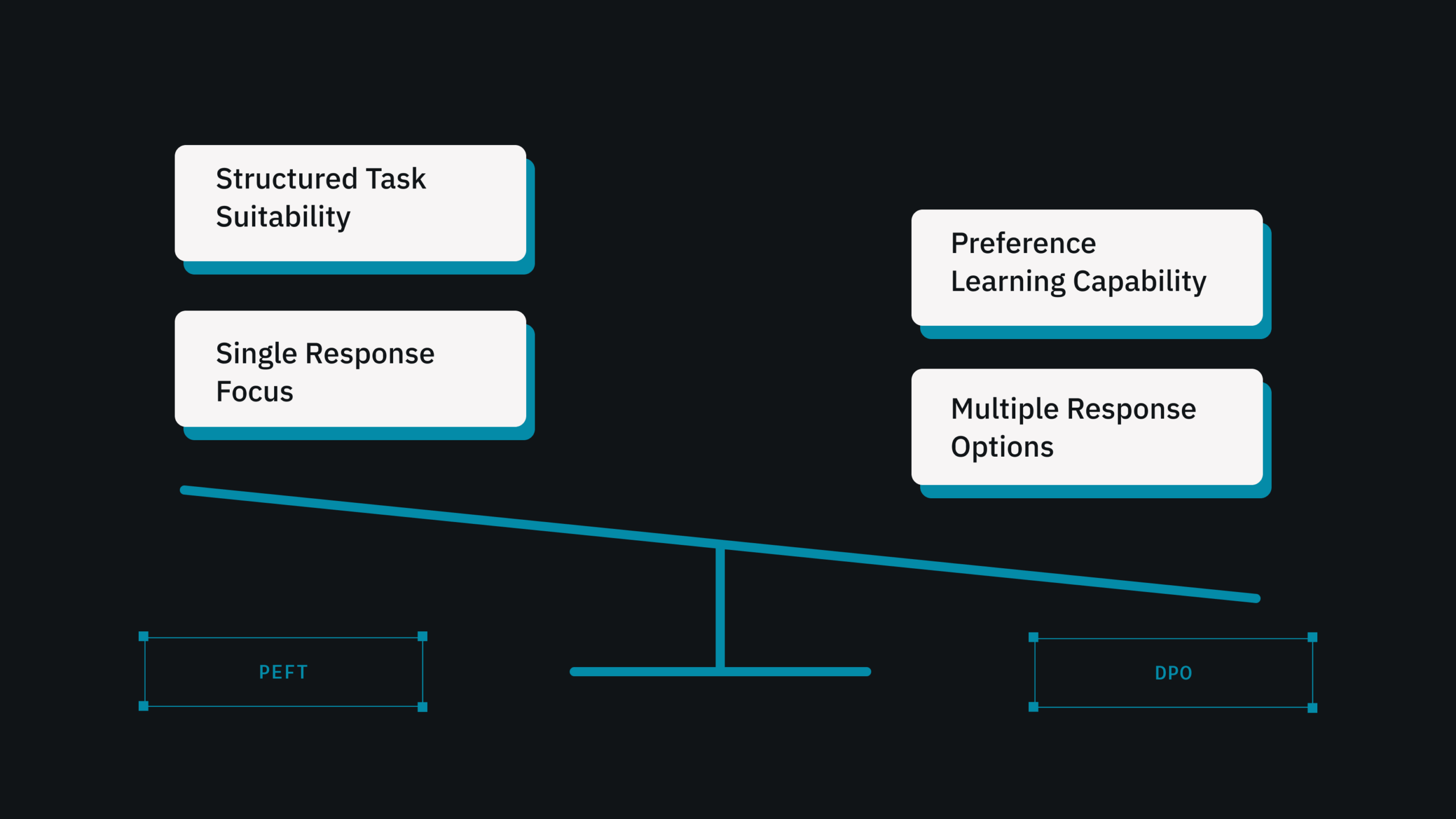
    Parameter-Efficient Fine-Tuning: PEFT is a more efficient fine-tuning method that only changes a portion of the model’s parameters. PEFT (Prefix-Tuning for Efficient Adaptation of Pre-trained BERT) is a widely used approach with promising outcomes.

    Direct Preference Optimization: DPO aligns models to human-like preferences and ranking behaviors. Ideal for picking multiple types of responses.

    DataNeuron supports both PEFT and DPO workflows, providing scalable, enterprise-grade model customisation. These solutions enable enterprises to quickly adapt to new use cases without requiring complete model retraining. 

    If your work does not change substantially and the responses follow a predictable pattern, fine-tuning is probably your best option.

    What is a Multi-Agent System?


    Instead of one expert, you have a group of agents performing tasks in segments. One person is in charge of planning, another collects data, and another double-checks the answer. They work together to complete a task. That’s a multi-agent system, multiple LLMs (or tools) with different responsibilities that work together to handle complicated operations.

    A multi-agent system involves multiple large language models (LLMs) or tools, each with distinct responsibilities, collaborating to execute complex tasks.

    At DataNeuron, our technology is designed to allow both hierarchical and decentralized agent coordination. This implies that teams may create workflows in which agents take turns or operate simultaneously, depending on the requirements.

    Agent Roles: Planner, Retriever, Executor, and Verifier

    In a multi-agent system, individual agents are entities designed to perform specific tasks as needed. While the exact configuration of agents can be built on demand and vary depending on the complexity of the operation, some common and frequently deployed roles include:

    Planner: Acts like a project manager, responsible for defining tasks and breaking down complex objectives into manageable steps.

    Retriever: Functions as a knowledge scout, tasked with gathering necessary data from various sources such as internal APIs, live web data, or a Retrieval-Augmented Generation (RAG) layer.

    Executor: Operates as the hands-on worker, executing actions on the data based on the Planner’s instructions and the information provided by the Retriever. This could involve creating, transforming, or otherwise manipulating data.

    Verifier: Plays the role of a quality assurance specialist, ensuring the accuracy and validity of the Executor’s output by identifying discrepancies, validating findings, and raising concerns if issues are detected.

    These roles represent a functional division of labor that enables multi-agent systems to handle intricate tasks through coordinated effort. The flexibility of such systems allows for the instantiation of these or other specialized agents as the specific demands of a task dictate.

    Key Features:

    • Agents may call each other, trigger APIs, or access knowledge bases.
    • They could be specialists (like a search agent) or generalists.
    • Inspired by how individuals delegated and collaborated in teams.

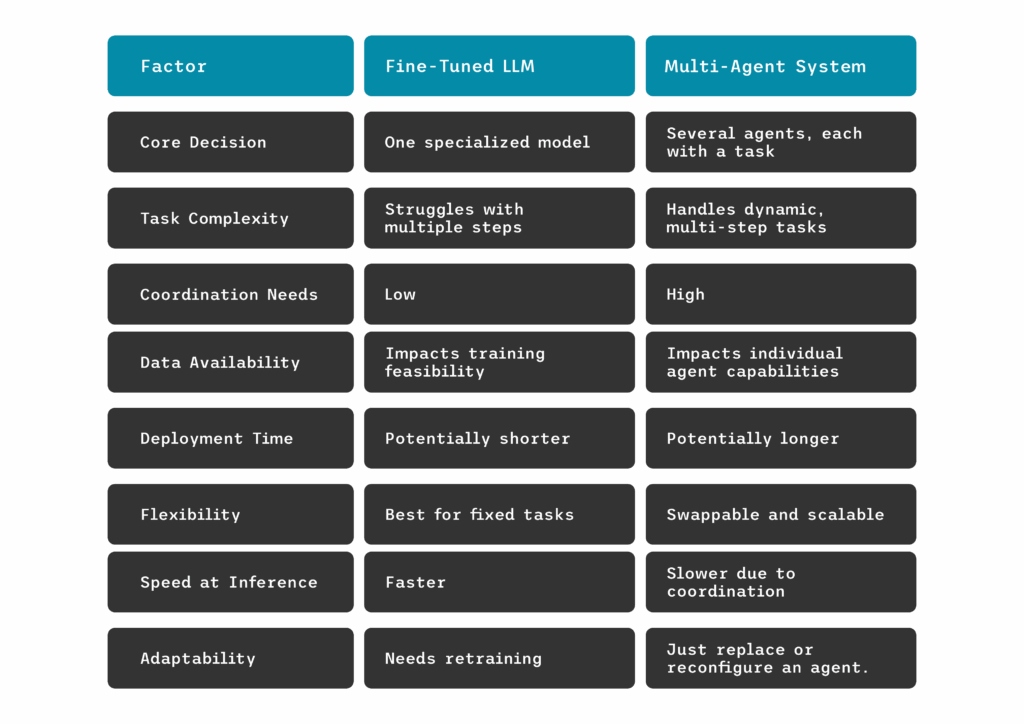
    Choosing Between Fine-Tuned LLMs and Multi-Agent Systems: What Points to Consider

    Data In-Hand

    If you have access to clean, labeled, domain-specific data, a fine-tuned LLM can generate high precision. These models thrive on well-curated datasets and learn only what you teach them.

    Multi-agent systems are better suited to data that is dispersed, constantly changing, or unstructured for typical fine-tuning. Agents such as retrievers may extract essential information from APIs, databases, or documents in real time, eliminating the need for dataset maintenance.

    Task Complexity

    Consider task complexity as the number of stages or moving pieces involved. Fine-tuned LLMs are best suited for targeted, repeated activities. You teach them once, and they continuously perform in that domain.

    However, when a job requires numerous phases, such as planning, retrieving data, checking outcomes, and initiating actions, a multi-agent method is frequently more suited. Different agents specialize and work together to manage the workflow from start to finish.

    Need for Coordination

    Fine-tuned models may be quite effective for simple reasoning, especially when the prompts are well-designed. They can use what they learnt in training to infer, summarize, or produce.

    However, multi-agent systems excel when the task necessitates more back-and-forth reasoning or layered decision-making. Before the final product goes into production, a planner agent breaks down the task, a retriever recovers information, and a validator verifies for accuracy.

    Time to Deploy

    Time is typically the biggest constraint. Fine-tuning needs some initial investment: preparing data, training the model, and validating results. It’s worth it if you know the assignment will not change frequently.

    Multi-agent systems provide greater versatility. You can assemble agents from existing components to get something useful up and running quickly. Need to make a change? Simply exchange or modify an agent; no retraining is required.

    Use Cases: Fine-Tune Vs. Multi-Agent

    The best way to grasp a complicated decision is through a few tangible stories. So here are some real-world scenarios that make the difference between fine-tuned LLMs and multi-agent systems as clear as day.

    Scenario 1: Customer Support Chatbot

    Company: HealthTech Startup

    Goal: Develop a chatbot that responds to patient queries regarding their platform.

    Approach: Fine-Tuned LLM

    They trained the model on:

    • Historical support tickets
    • Internal product documentation
    • HIPAA-compliant response templates

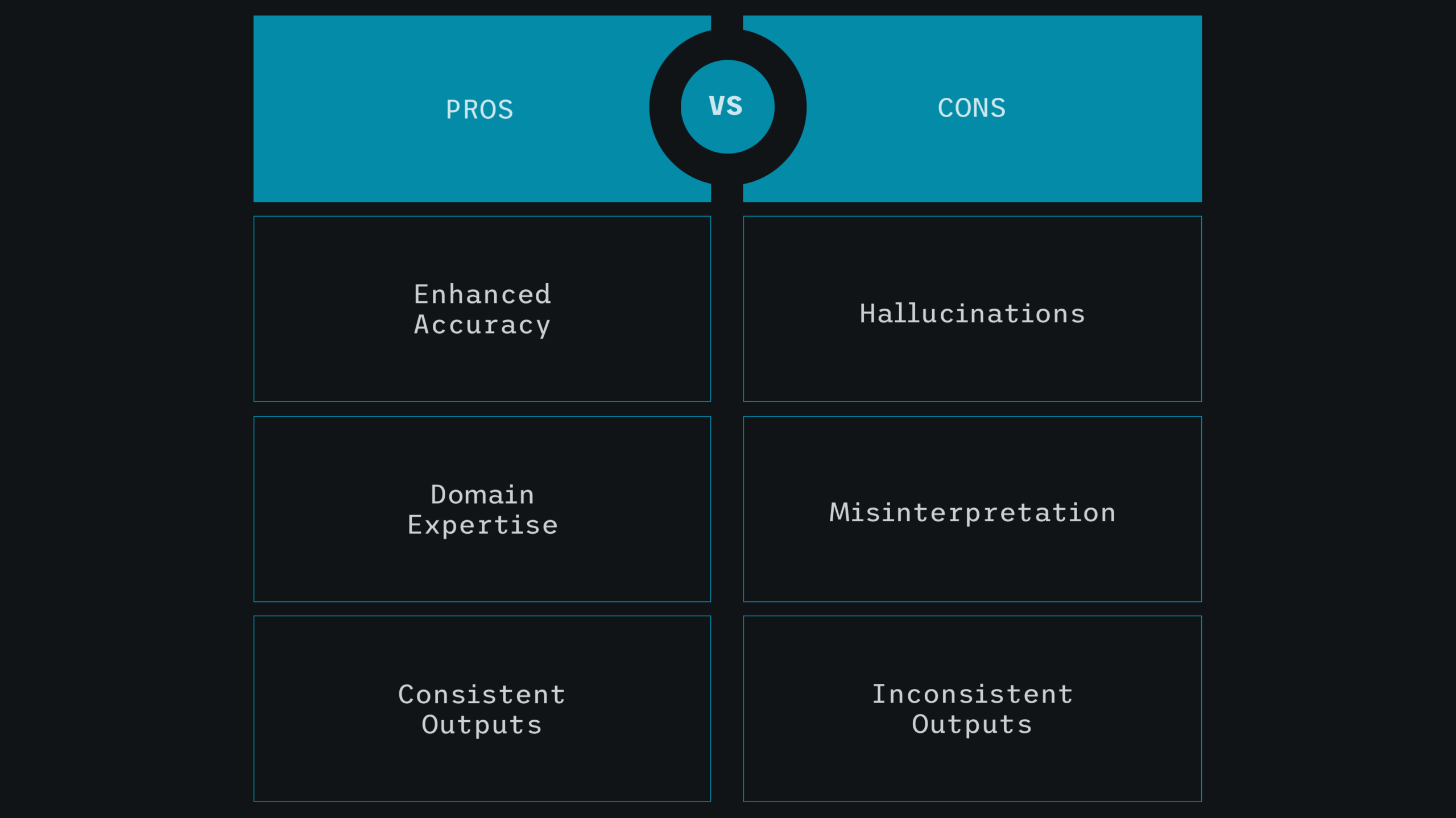
    Why it works: The chatbot provides responses that read on-brand, maintain compliance rules, and do not hallucinate because the model was trained in the company’s precise tone and content.

    Scenario 2: Market Research Automation

    Business: Online Brand

    Objective: Be ahead of the curve by automating product discovery.

    Approach: Multi-Agent System

    The framework includes:

    • Search Agent to crawl social media for topically relevant items
    • Sentiment and Pattern Recognition Analyzer Agent
    • Strategic Agent to advise on product launch angles

    Why it works: The system constantly monitors the marketplace, learns to adjust to evolving trends, and gives actionable insights that are free from human micromanagement.

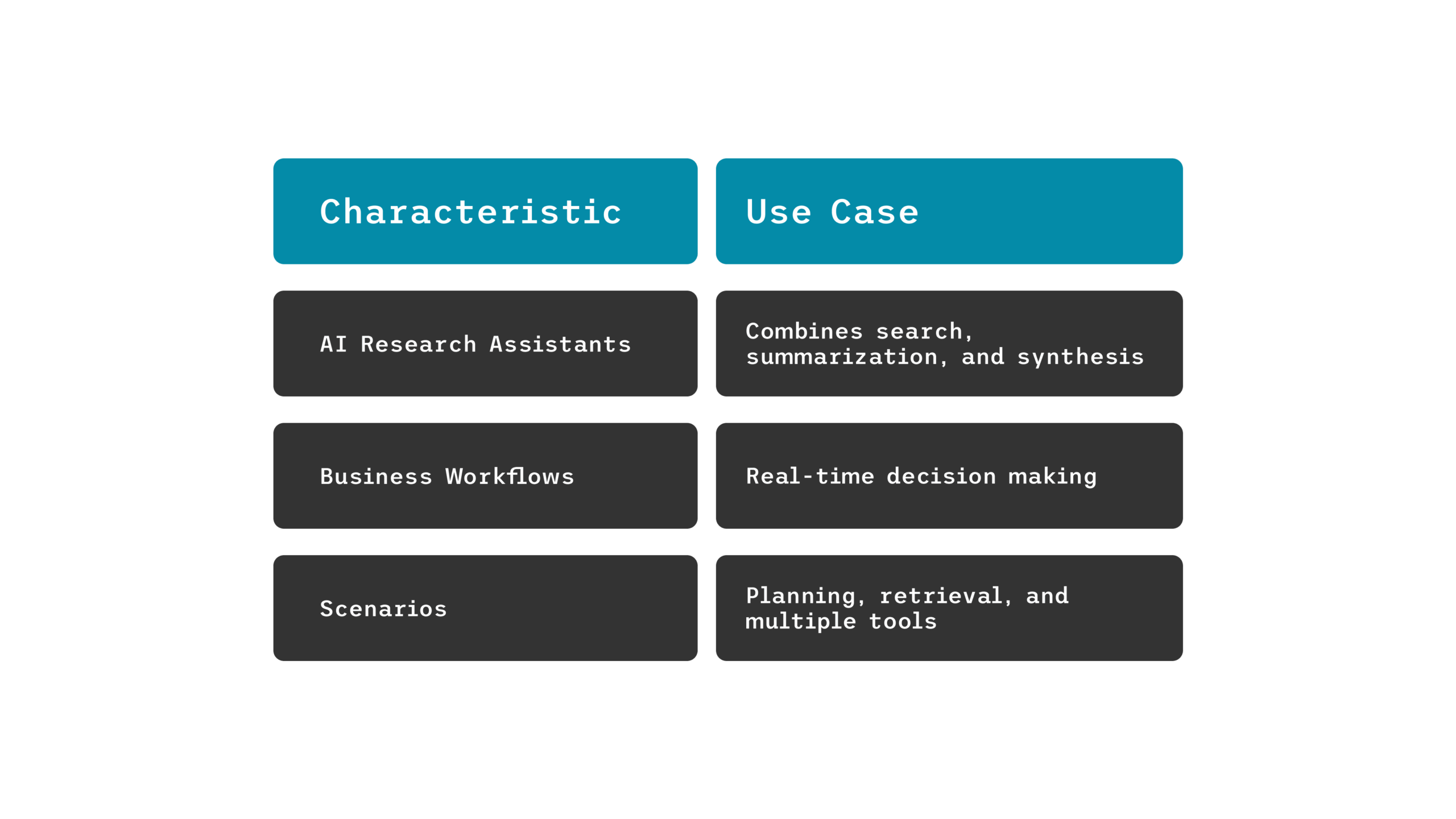
    At DataNeuron, we built our platform to integrate fine-tuned intelligence with multi-agent collaboration. Here’s what it looks like: Various agents, both pre-built and customizable, can be used for NLP tasks like NER, document search, and RAG. Built-in agents offer convenience for common tasks, while customizable agents provide flexibility for complex scenarios by allowing fine-tuning with specific data and logic. The choice depends on task complexity, data availability, performance needs, and resources. Simple tasks may suit built-in agents, whereas nuanced tasks in specialized domains often benefit from customizable agents. Advanced RAG applications frequently necessitate customizable agents for effective information retrieval and integration from diverse sources.

    So, whether your activity is mundane or dynamically developing, you get the ideal blend of speed, scalability, and intelligence. You don’t have to pick sides. Instead, choose what best suits your business today. We are driving this hybrid future by making it simple to design AI that fits your workflow, not the other way around.

  • Mastering LLMs with DataNeuron: Why Data Curation is the Real Game Changer

    Mastering LLMs with DataNeuron: Why Data Curation is the Real Game Changer

    The adoption of Large Language Models (LLMs) has transformed how industries function, unlocking capabilities from customer support automation to improving human-computer interactions. Their adoption is soaring, with MarketsandMarkets projecting the global LLM market to grow at a compound annual growth rate (CAGR) of over 35% in the next five years. Yet, many businesses that rush to adopt these models are discovering a critical insight: the model itself isn’t what sets you apart your data does.

    While impressive, pre-trained LLMs are fundamentally generalists. They are trained on a broad, diverse pool of public data, making them strong in language understanding but weak in context relevance. A well-curated dataset ensures that an LLM understands industry jargon, complies with regulatory constraints, and aligns with the client’s vision. 

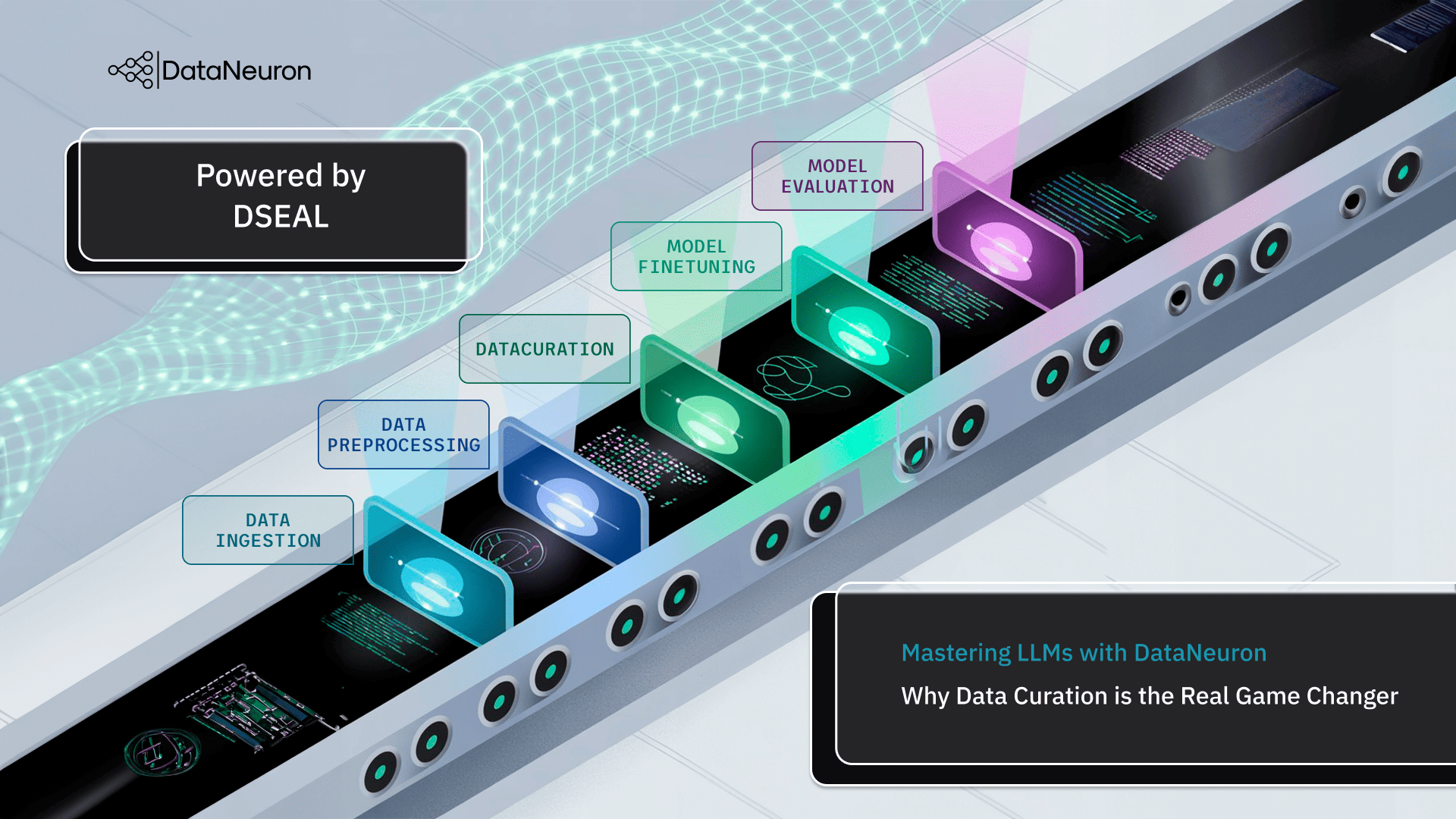
    At DataNeuron, we’ve built our approach around this idea. Our Divisive Sampling for Efficient Active Learning (DSEAL) framework redefines what it means to prepare data for fine-tuning. Rather than throwing thousands of generic examples at a model, DSEAL enables the creation of focused, instructive, and diverse datasets while maintaining speed and confidentiality with minimal manual intervention. 

    Why Data Curation is the Hidden Engine Behind Fine-Tuning

    You wouldn’t train a legal assistant with engineering textbooks. Yet many enterprises expect LLMs trained on internet data to perform highly specialized tasks with minimal adaptation. This mismatch leads to a familiar set of issues: hallucination, shallow reasoning, and a lack of domain fluency

    The data that the model has or hasn’t seen contributes to these challenges. Fine-tuning a model with domain-specific examples allows it to grasp the nuances of your vocabulary, user expectations, and compliance norms. Nonetheless, fine-tuning is sometimes misinterpreted as a process concentrated on coding.
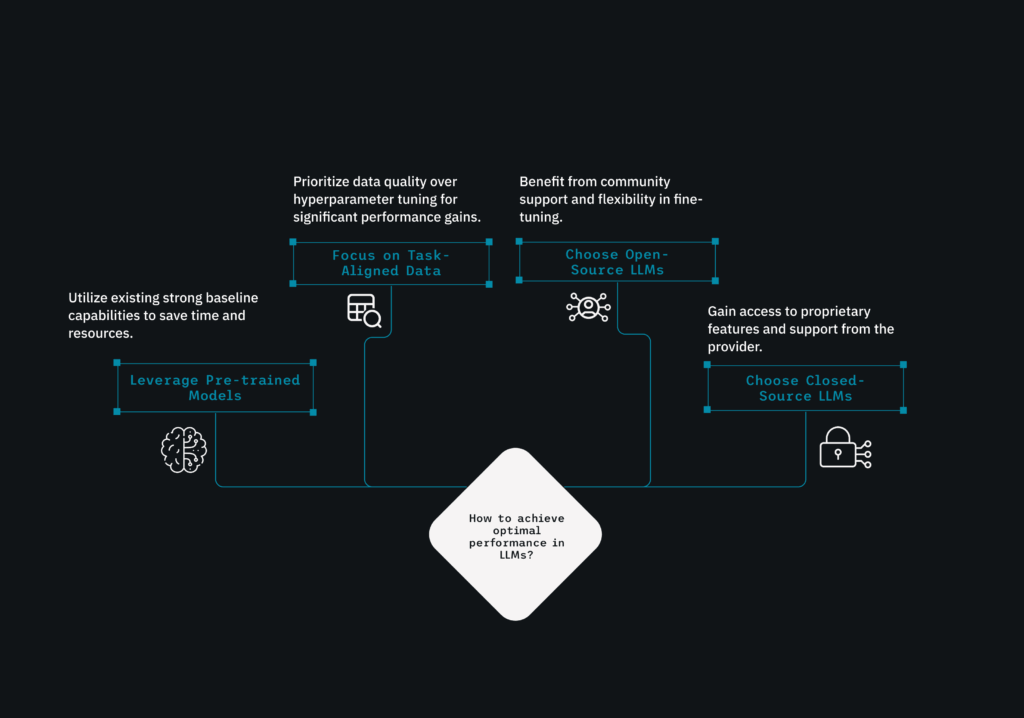
    In practice, 80% of successful LLM fine-tuning depends on one factor: the correct data. We provide two fine-tuning options: PEFT and DPO, both of which are fully dependent on the quality of the incoming dataset. 

    Without sufficient curation, fine-tuning can provide biased, noisy, or irrelevant results. For instance, a financial LLM trained on poorly labeled transaction data may misidentify fraud tendencies. A healthcare model analyzing unstructured clinical notes may make harmful recommendations. 

    LLM Customization Starts with Curation, Not Code

    Enterprises often approach LLM customization like a software engineering project: code first, optimize later. But with LLMs, data>code is where the transformation begins. Fine-tuning doesn’t start with scripts or API’s, it begins with surfacing the right example from your data sources. 
    Whether you employ open-source models or integrate with closed APIs, the uniqueness of the dataset makes our platform an ideal place to collaborate. Your support tickets, policy documents, email logs, and chat exchanges include an array of concealed data. However, they are distorted, inconsistent, and unstructured.

    Curation turns this raw material into clarity. It is the process of identifying relevant instances, clearing up discrepancies, and aligning them with task requirements. At scale, it enables LLMs to progress from knowing a lot to understanding what matters.

    This is why our clients don’t start their AI journey by deciding whether to use GPT or Llama; they begin by curating a dataset that reflects the tasks they care about. With the correct dataset, any model can be trained into a domain expert.

    DataNeuron’s platform automates 95% of dataset creation, allowing businesses to prioritize strategic sampling and validation over human labeling. And the output? DataNeuron’s prediction API enables faster deployment, improved accuracy, and smoother integration.

    Why Scaling Data Curation is Challenging Yet Important 

    For most companies, data curation is a bottleneck. It’s easy to underestimate how labor-intensive this procedure may be. Manually reviewing text samples, labeling for context, and ensuring consistency is an inefficient procedure that cannot be scaled.

    We focus on quality over volume. Models trained using irrelevant or badly labeled samples frequently perform worse than models that were not fine-tuned at all. Add to this the complexities of data privacy, where sensitive internal documents cannot be shared with external tools, and most businesses find themselves trapped.

    This is where we invented the DSEAL framework, which revolutionized the equation.

    How DataNeuron’s DSEAL Framework Makes High-Quality Curation Possible

    DSEAL is our solution to the most common problems in AI data preparation. DSEAL solves a basic issue in machine learning: the inefficiency and domain limitation of classic active learning methods. It’s a system designed to automate what’s slow, eliminate what’s unnecessary, and highlight the things that matter. 

    What makes DSEAL different from others?

    • 95% Curation Automation: From ingestion to labeling, the system does the majority of the labor.
    • Task-aligned sampling: DSEAL strategically samples across edge cases, structures, and language trends rather than random examples.
    • Instruction-First Formatting: The curated data is organized to match instruction-tuned models, increasing relevance and accuracy.
    • Private by Design: All processes run inside the enterprise environment; no data leaves your perimeter. 

    The change from brute-force annotation to smart, minimum, domain-adaptive sampling distinguishes DSEAL in today’s noisy and model-saturated market.

    Key Takeaways 

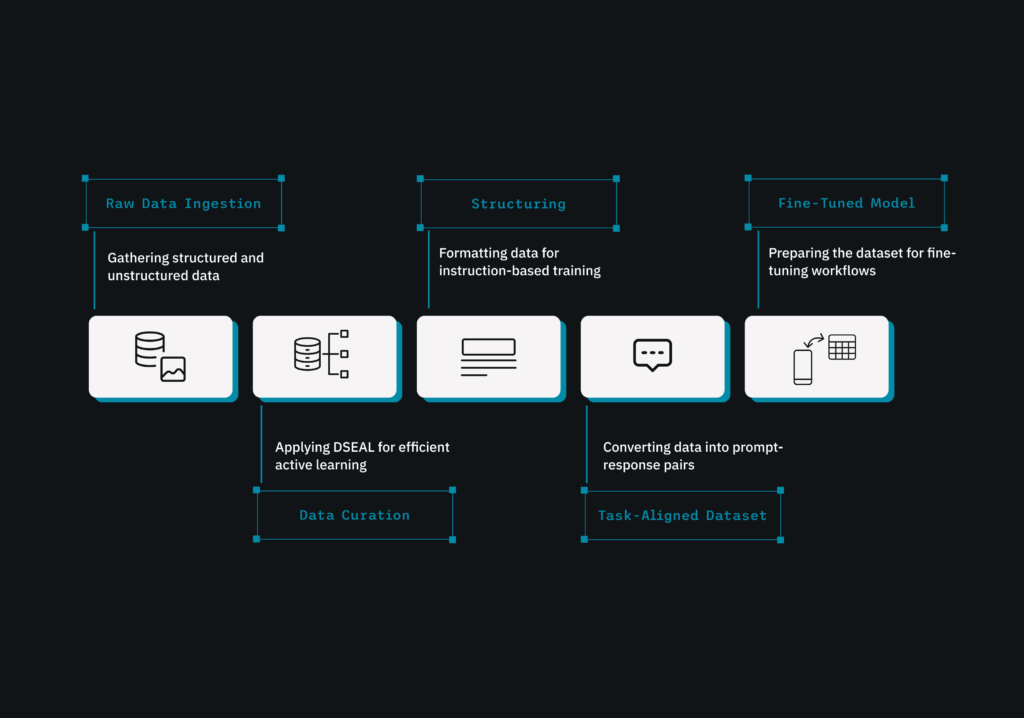
    From raw to model-ready in four steps:

    1. Raw Data Ingestion: Whether it’s email threads or chat logs, the data enters the system untouched.
    2. Cleaning and Structuring: We remove duplicates, normalize formats, and extract only the content that is relevant to your aims.
    3. Instruction formatting: It involves converting data into prompt-response pairs or structuring it for preference-based training.
    4. Model-Ready Dataset: The completed dataset is ready for fine-tuning procedures, complete with traceability and metrics.

    Fine-tuning is no longer about model design but about context and detail. Your business already has everything it needs to create world-class AI: its data. The difficulty lies in converting the data into a structured, informative resource from which an LLM may learn.

    With DSEAL, DataNeuron turns curation from a manual bottleneck to a strategic advantage. We help you go from data chaos to clarity, providing your models the depth and focus they require to operate in the real world.