If the internet allowed everyone to send data, but there were no rules (like HTTP, TCP/IP, or DNS) on how to format, interpret, or verify it. One site would send text as images, another as binary, and another with no headers. You could connect, but you’d rarely understand what was sent. That’s what MAS looks like without A2A (Agent-to-Agent Protocol).
The Model Context Protocol (MCP) gives multi-agent systems (MAS) a shared communication channel. A2A provides the contractual rules of interaction, making them reliable enough for enterprise and cross-organizational use.
Why Multi-Agent Systems Struggle Without A2A
Even with a strong communication layer (MCP), MAS still face critical shortcomings when there’s no governing protocol like A2A:
- Ambiguity of meaning
- Lack of trust
- Security vulnerabilities
- Compliance gaps
- Cross-boundary failures
In short, without A2A, multi-agent systems remain prone to misalignment and unsuitable for real-world enterprise environments.
How A2A Works
A2A operates through a set of principles that bring clarity and governance to MAS:
- Structured Messages
Every message comes with a strict schema with defined types, context, and intent, so ambiguity is removed. - Authentication & Trust
Messages can be cryptographically signed, allowing agents to verify the sender’s identity and authority. - Validation Rules
Before acting, agents validate whether a message conforms to agreed-upon standards. - Governance Layer
A2A encodes rules of interaction: who can do what, under what conditions, and with what accountability. - Cross-Boundary Collaboration
Agents across organizations or domains can work together without being tightly coupled, thanks to standardized contracts.
A2A in Action:
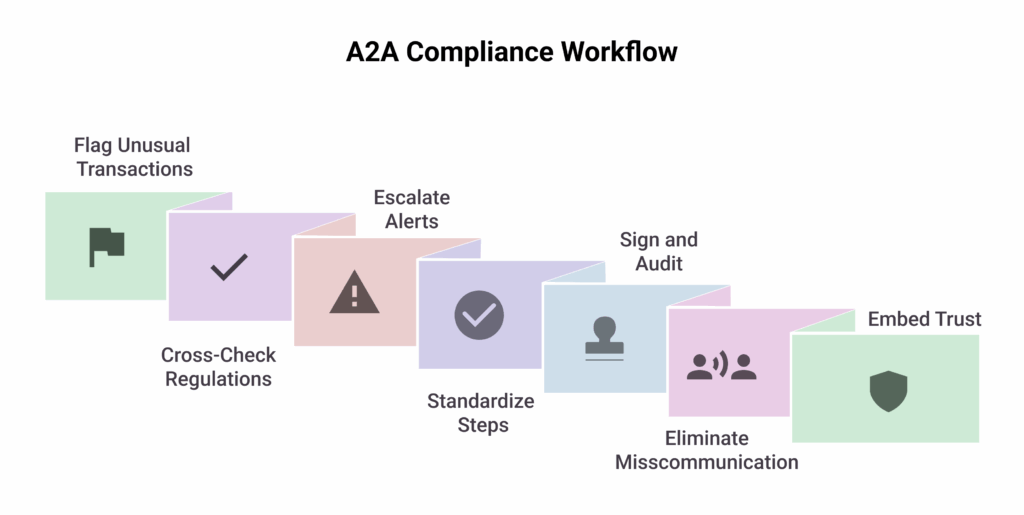
With A2A, every step is standardized, signed, and auditable.
By building A2A into our platform, we ensure that agent-to-agent communication isn’t just possible, but governed and reliable. This approach helps organizations:
- Operate multi-department workflows with confidence.
- Collaborate securely with external vendors’ agents.
- Maintain compliance without adding manual oversight.
Our mission is to make MAS not only intelligent but also accountable. A2A is the step that makes that possible.
Why A2A Shapes the Future of Agentic AI
Looking ahead, we believe A2A will define how agent ecosystems evolve in three key ways:
- Governed Autonomy
Agents won’t just act independently; they’ll act within enforceable rules and standards. - Cross-Organizational Collaboration
As businesses connect agents across ecosystems, A2A will be the “link language” that ensures safe cooperation. - Trusted Intelligence
Enterprises will demand explainable, auditable AI- A2A provides the contractual layer to deliver it.
At DataNeuron, we move toward ecosystems of interoperable agents, and we believe A2A will be the reason they can do so with confidence.
Leave a Reply